
“In His Joy”
The Man in the Field
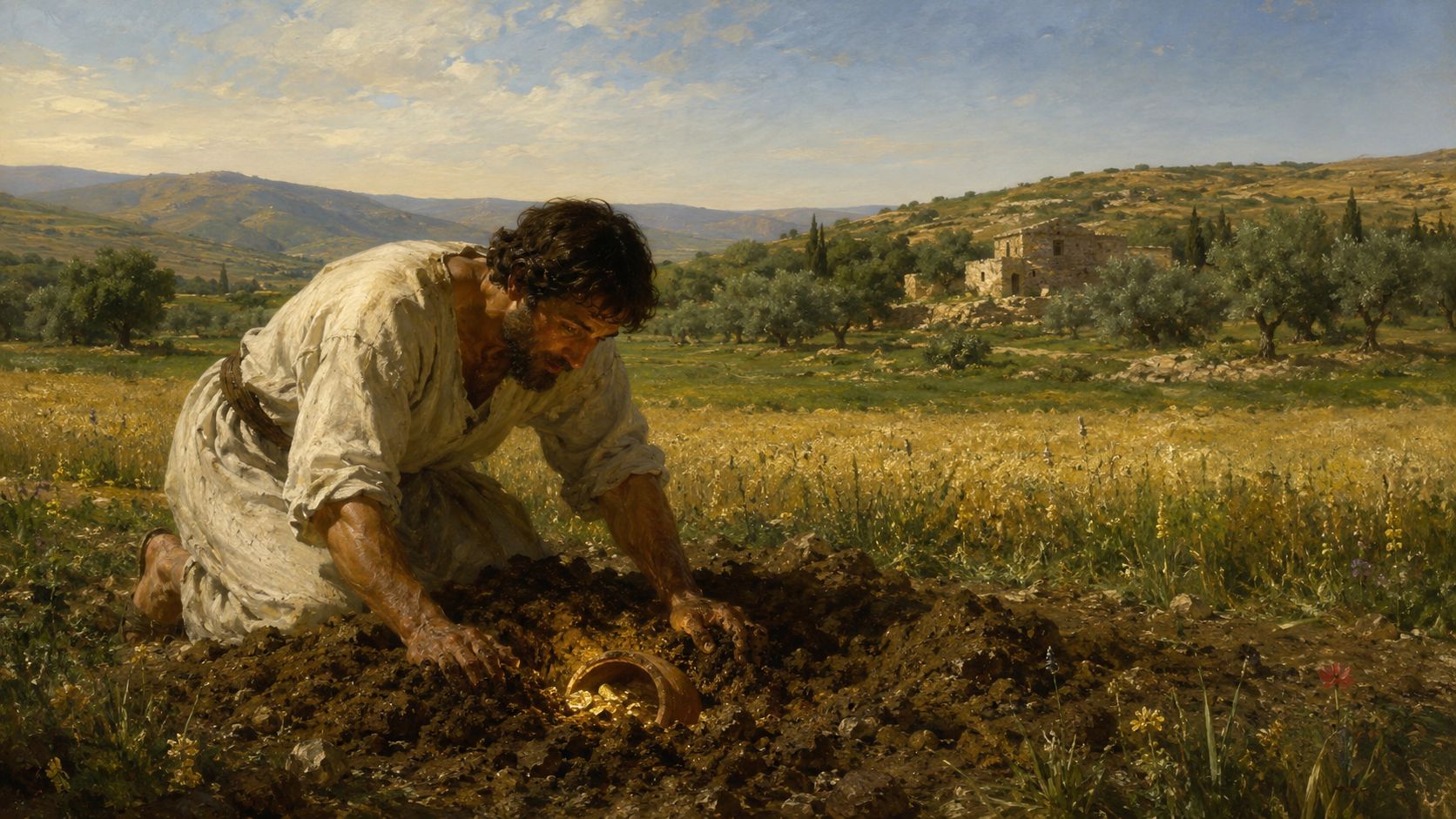
The field is not his. That is the first thing to know about the man, and very nearly the last thing the parable troubles to say about him. He is working ground that belongs to someone else — a hired laborer, most likely, breaking clods on a summer morning like a hundred mornings before it — when the edge of his shovel strikes something that is not a stone.
He clears the dirt away. He sees what it is. And then he does something strange: he covers it back over. He kneels in the turned earth and hides the thing again, exactly as he found it, and walks home across the field with his heart going like a hammer. He has already done the arithmetic, there in the dirt, and he knows what comes next. He is going to sell everything he owns.
Not the treasure — he cannot sell the treasure; it is not his yet. He is going to buy the field. A man cannot buy what is not for sale, so he will buy all the dirt on top of it, every worthless acre he never wanted, to own the one thing he does. The parable is running hard on one thing, and it is not the real estate.
“The kingdom of heaven is like treasure hidden in a field, which someone found and hid; then in his joy he goes and sells all that he has and buys that field.”Matthew 13:44 (NRSV)
Everything is in the hinge of that sentence. In his joy he goes and sells all that he has. Four small words, and they carry the whole weight.
In His Joy
Here is what most people brace for when the reading reaches sold all that he had. They know the move. Here comes the part where religion asks for more than they have — more money, more time, more of a life already stretched thin enough to tear. Faith as another invoice, stamped past due.
But that is not what Matthew wrote. He did not write that the man sold everything and it was hard, that he set his jaw and did the responsible thing. He wrote that in his joy the man went and sold. The joy came first. The joy is the reason the selling was even possible, and the reason it never once felt like loss.
Joachim Jeremias, who gave a scholar’s lifetime to these parables, had a name for that feeling — eschatological joy, the gladness so complete it makes the cost weigh nothing at all. And there is a portrait of it, of all places, in a Genesis love story. Jacob labors seven years for Rachel, and Scripture says they seemed to him but a few days because of the love he had for her. Seven years, felt like a week — not because the work was light, but because of what waited on the far side of it. That is the arithmetic the man in the field has already run. Sell it all; it will feel like nothing.
Which quietly changes what kind of story this is. It is not a story that raises the price on anyone. It is a story that asks a different question altogether: not what will it cost, but when did a person last look hard at what they are already holding.
Two Who Found It
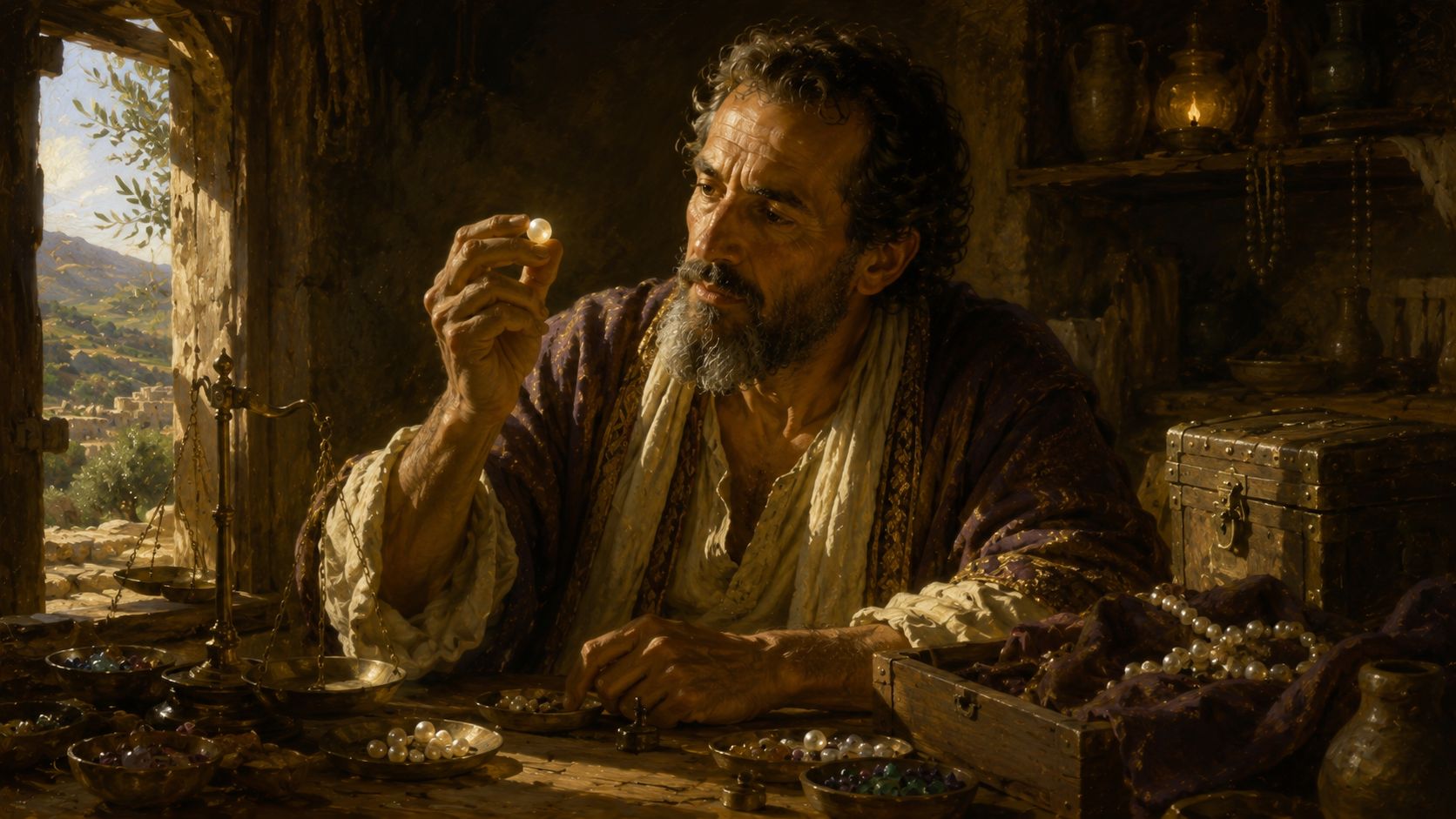
Jesus tells it twice, and the second telling is not a repetition. It is a correction, aimed at anyone who thinks the first man simply got lucky.
The first man was not looking. He tripped over the treasure in the course of an ordinary day’s work in someone else’s dirt. But the second man has been looking his whole life. A merchant in search of fine pearls — that is his trade, his craft, thirty years of holding gems to the light and knowing to the coin what they are worth. And then, one day, he sees the one.
“On finding one pearl of great value, he went and sold all that he had and bought it.”Matthew 13:46 (NRSV)
Consider what that costs a professional. A merchant who liquidates his entire inventory for a single pearl has done something commercially absurd — he cannot resell it without undoing the purchase, so the deal ends his career. He gets one thing, stops being what he was, and by every sign has never in his life been happier.
Two men. One stumbled; one searched for thirty years. And Matthew sets them side by side and flatly refuses to say which one is the real conversion.
The refusal is deliberate, and it is for a particular kind of room. Some were raised inside the faith, cannot remember a day they did not believe, and carry a quiet worry that a belief without a dramatic before-and-after is somehow thinner than the kind that arrives in a crisis. Others came in the hard way — after the whole structure of a life came down — and carry the opposite worry, that they arrived too late to really count. The parable answers both at once. The man who stumbled and the man who searched buy the same field at the same price, and the field does not care how either of them came to it.
It Started Small
And it started small. Before Jesus said a word about treasure, he told the crowd two smaller things. A mustard seed — the kind you could lose in the seam of a coat — becomes a shrub wide enough that the birds of the air come and nest in its branches. And a woman takes a pinch of yeast and hides it — that is the verb Matthew chooses — in fifty pounds of flour, bread enough for a hundred people, and says nothing and does nothing while the whole batch quietly turns. No one watching that dough could name the hour it changed.
That is how God has almost always worked. Underground. Out of sight. At a scale that does not photograph well. Which means the thing that looks too small to count — a faith gone quiet, a prayer that never got past a groan — was never the true measure of what is being made of it.
“The Spirit helps us in our weakness … that very Spirit intercedes with sighs too deep for words.”Romans 8:26 (NRSV)
Even the groan, Paul says, is the Spirit at prayer. The smallest thing a person carries was never as small as it looked, and never only theirs to carry. There was a furnace in the last of these parables — the net, the sorting, the fire — and its verdict has not changed: the sorting is real, it comes at the end, and it was never any tender’s task. No one working the field was ever handed the net.
Back to the Field

So the parable leaves a question lying in the middle of the floor. When did this last feel like treasure — the faith, the grace, the whole of it — and not like one more thing to keep up?
The good news is the very reason the man could be so glad. Someone came to a field where nothing showed on the surface, ground no one else thought worth checking, and knew exactly what was buried there, and found it. Paul says the same thing without the parable: God did not withhold his own Son. That is the measure of the field’s worth, and it was paid gladly — in his joy.
And the leaven is still working. The dough is not finished. Whatever was buried in a life while no one was watching is still growing, underground, and the joy of the One who found it does not run out before the harvest does. Joy like that is never manufactured; no one works it up on command. It is found, the way a man finds a treasure he was not looking for in a field he was only crossing. The end of the parable is not an order to try harder, but an invitation: go back to the field, look again at what is already in hand, and be glad.
A Closing Prayer
God of hidden things, we have spent so long appraising the wrong treasure. Open our eyes to what we are already holding. Give us the joy that makes generosity weightless, the gladness that never once feels like losing. Work in us underground, where we cannot watch — in the small seed, in the hidden leaven, in the sighs too deep for words — until all of it is leavened and the morning comes. And when we forget what we have, come and find us again, as you always have. Amen.