
“Rock and Stumbling Stone”
Six Verses Apart
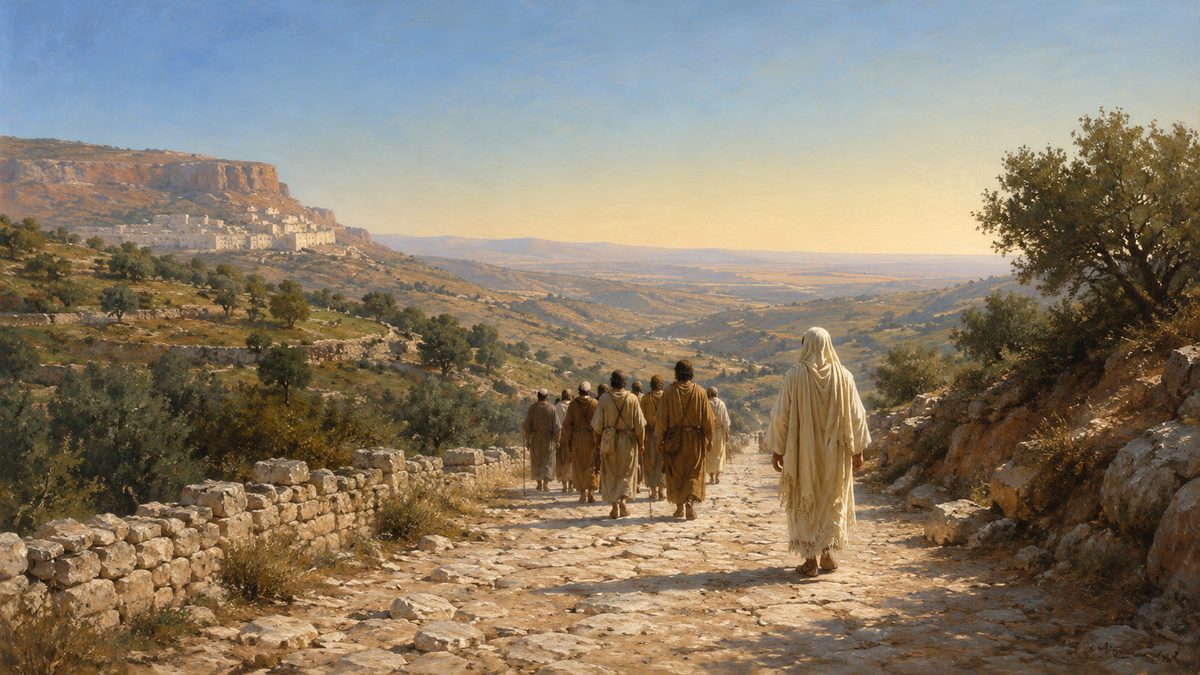
Somewhere on the road south out of Caesarea Philippi, a man puts his hand on Jesus’ arm and steers him off the path, away from the others, so that what he is about to say will not be overheard.
He is not a stranger. He is the one who got it right. Six days ago this congregation heard him do it — blessed by name for it, given a new name of his own. You are Peter. Rock. And on this rock I will build my church.
Now he has his Lord by the elbow, out of earshot, explaining that he has the road wrong.
Six verses. That is the whole distance between you are Rock and what Jesus says to him this morning. Matthew set the two side by side on purpose.
The Most Human Sentence in the Chapter
“From that time on, Jesus began to show his disciples that he must go to Jerusalem and undergo great suffering… and be killed, and on the third day be raised.”Matthew 16:21 (NRSV)
Matthew marks that sentence. He has used from that time on once before — from that time Jesus began to proclaim, “Repent, for the kingdom of heaven has come near.” Twins. After the second one the subject changes and never changes back. From here to the end of the book, the Messiah explains his cross.
Elders, chief priests, scribes: the Sanhedrin, named as a body. This will not be a mob. It will be a vote.
And hear how the sentence ends. And on the third day be raised. It is there every time he says this, and not once does anyone appear to hear it. Grief is a poor listener, and Matthew knows it.
Peter does not hear it. He takes Jesus by the arm — in Greek, the gesture of drawing a man aside to yourself, private, almost tender — and says, God forbid it, Lord. This must never happen to you.
You will want to defend him. So do I. He is not being faithless. He is defending someone he loves from a future he cannot stand to look at. Most of us have said some version of it standing next to a bed.
But look at the verb. Peter rebukes him — the word this Gospel uses when Jesus silences a fever, a demon, a storm on the lake. Peter takes his Lord by the arm and speaks to him the way his Lord speaks to chaos.
He had the title exactly right and the road completely wrong. And notice which half was his. The confession had been handed to him — flesh and blood has not revealed this to you, but my Father in heaven. The correction was his own work.
The Same Two Words
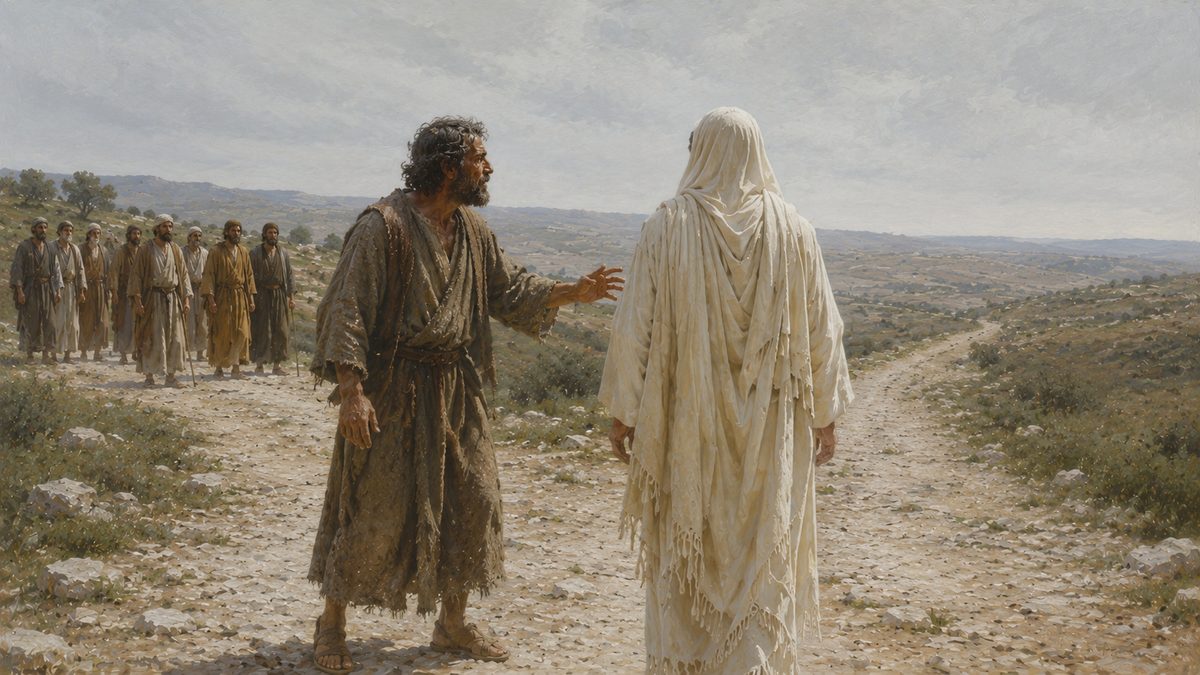
“Get behind me, Satan! You are a stumbling block to me; for you are setting your mind not on divine things but on human things.”Matthew 16:23 (NRSV)
Two things about that sentence, and the second one is the sermon.
The first: the charge is not that Peter’s facts are wrong. You are setting your mind — the word underneath is not about opinions. It is about which way a whole life is pointed. Jesus is not correcting a sentence. He is turning a compass.
The second: get behind me is, in Greek, two words. Behind me. Hold on to them.
Because one verse later he says to all of them, If any want to become my followers — and the Greek reads, if anyone wants to come behind me. The same two words. The rebuke and the invitation are the identical phrase.
Which means get behind me is not get away from me. It is get back to your place — and your place is behind me, and it is still open.
Peter’s failure was not distance. It was position. He had gotten out in front of the one he had just confessed, turned around, and started telling him where the road went.
And stumbling block — Isaiah put both stones in one sentence centuries before: the LORD who is a sanctuary, and a stone one strikes against, a rock one stumbles over. Same rock. It depends which way you are walking.
What the Place Behind Him Asks
“If any want to become my followers, let them deny themselves and take up their cross and follow me.”Matthew 16:24 (NRSV)
Now that we know where the place is, we can hear what it asks.
Deny themselves. Matthew uses that verb in exactly two places. Here — and in chapter twenty-six, where Peter denies Jesus three times before a rooster finishes crowing. Same verb, same man. The one who got denial exactly backwards is the one Jesus keeps. So denying yourself is not despising yourself; those are two different religions. It is saying not mine about the thing you defend hardest — survivable only because it happens inside a belonging that does not break.
Take up their cross. In Galilee then, that was no figure of speech for a hard marriage or a bad back. Within living memory a Roman general had crucified two thousand men after a revolt and burned a town four miles from Nazareth. A man carrying a crossbeam through the street was being walked to his execution, and everyone knew it. Say it at full weight — and then say the other half, because this verse has been handed to people as a reason to stay where they are being harmed. The Greek is let him take it up. You pick it up. The cross Jesus means is the one you pick up because you followed him. It is never the one somebody else nailed you to.
And follow me. Present tense, continuous. Not a decision — a gait.
Then the arithmetic. Those who lose their life for my sake will find it — not get it back; find it, the way a man finds treasure in a field he was only crossing. What will they give in return for their life? Profit, gain, forfeit, exchange — the vocabulary belongs to the market, and the answer is the one the psalmist already knew. Nobody has the price. Four chapters later the Son of Man pays it himself.
Which is why the last line of our reading is not a threat. He will repay everyone for what has been done. Every account gets settled, and not by us — Paul told the Romans to leave vengeance to God. That is the guarantee that the invitation is not a swindle. You can afford to lose your life. The one who settles every account is the one you lost it for.
The Road South
Six days ago the crowd was guessing at his name, and one guess was Jeremiah. This morning the church reads Jeremiah himself — and hear what the prophet is permitted to say to God: you are to me like a deceitful brook, like waters that fail. A creek bed you crawl to in August and find dry. He said it to God’s face and was not struck down. The canon kept the sentence.
Jeremiah could not bear the road either. The difference is where he was standing when he said so. Jeremiah complained from behind. Peter stepped out in front.
And here is what the six verses were for. Jesus promised to build his church on this rock, and that the gates of Hades would not prevail — knowing that this same stone would trip him and deny him before the sun came up. The foundation was never the reliability of the man.
So if you have ever confessed him truly on Sunday and argued with him by Tuesday, certain of who he is and furious about what he is allowing, you are not the exception to this church. You are its foundation stone, exactly as delivered.
He is still walking. And the place behind him is not a demotion. It is where the view of the road comes from, and it is still open.
A Closing Prayer
Lord Jesus Christ, you knew what we were when you began building on us. You blessed Peter and rebuked him in the same conversation, and you never took the blessing back. We confess you truly and understand you poorly; we get your name right and your road wrong. When we have gotten out in front of you, turn us around — not away from you, but back behind you, where the road can be seen. Give us the honesty of Jeremiah, who told you the truth about his wound and was kept. And when we cannot bear where you are going, keep walking, and keep us with you. You are the Messiah, the Son of the living God, and the rock under this church has never been us.
In the name of the Father, and of the Son, and of the Holy Spirit. Amen.