
“The Broken Vessel”
There is a Japanese art form called kintsugi—the practice of repairing broken pottery with gold. When a bowl shatters, the artisan does not discard it. The pieces are joined back together with lacquer mixed with powdered gold, so that every crack becomes a luminous seam. The break becomes the most beautiful part of the vessel.
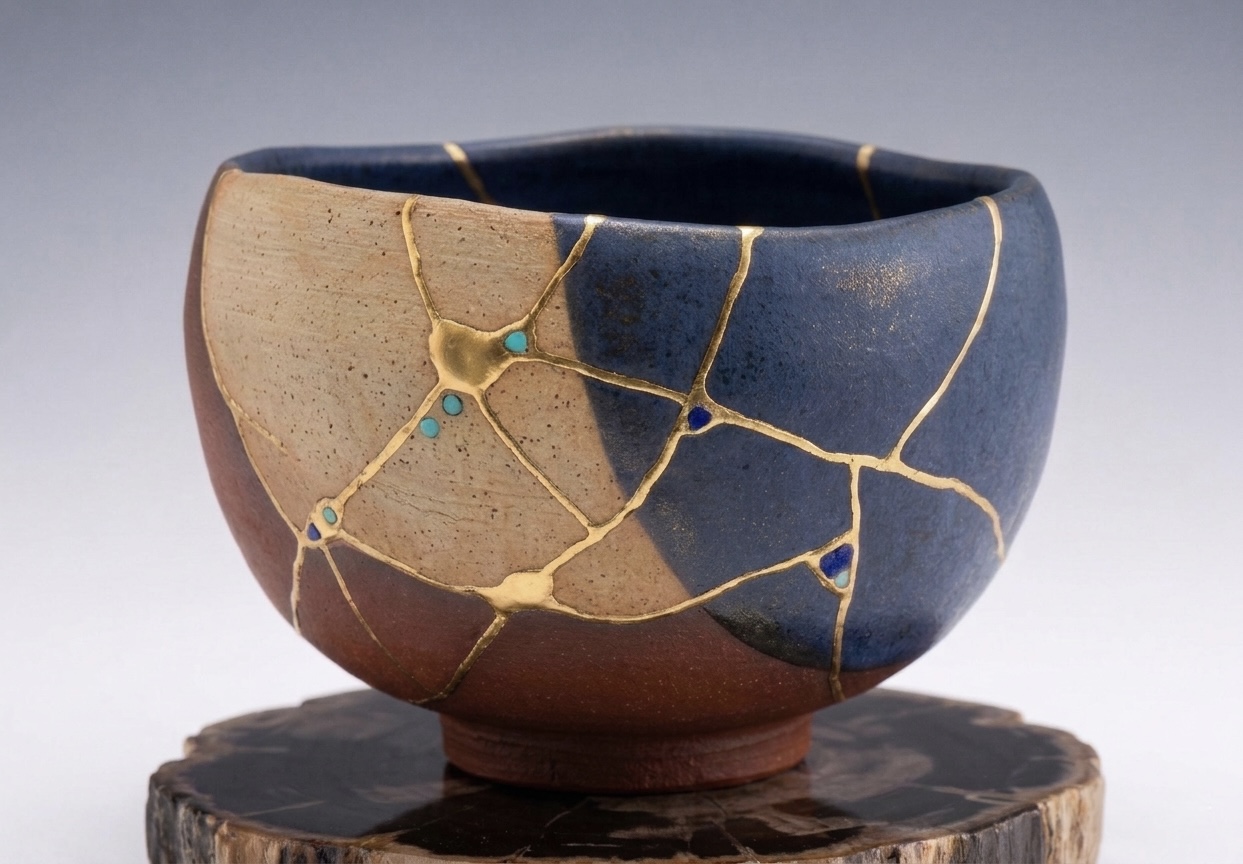
What these texts reveal—about the psalmist, about Christ, about us—is that brokenness is not the obstacle to God’s work. It is the very opening through which God’s work is accomplished. The word for this is kenosis—self-emptying—and it is the key to everything.
“A Broken Vessel”
The psalmist is falling apart. The language of Psalm 31 is ruthlessly physical: eye wasting from grief, soul and body spent, bones giving way. This is suffering that takes the whole person—body and spirit together, because Scripture does not separate them the way we have been trained to.
And the devastation is not only physical. It is social. The psalmist has become a scandal to his adversaries, a horror to his neighbors. People see him and cross to the other side. He has been erased from memory—“like one who is dead.”
Then comes the image that gives this sermon its name:
“I have become like a broken vessel.” —Psalm 31:12
A smashed pot. In the ancient world, a broken clay vessel was refuse—you threw it on the heap outside the city wall. It could not be repaired. It could not hold anything. It was finished.
Some of us know the feeling. Not as poetry but as address. The season when everything you were built to hold spills out through the cracks.
But notice what the psalmist does next. Verse 14:
“But I trust in you, O Lord; I say, ‘You are my God.’ My times are in your hand.” —Psalm 31:14–15
Nothing has changed. The enemies still plot. The body still wastes. And into that unchanged wreckage, the psalmist makes a declaration: You are my God. The broken vessel places itself—shards and all—into the hands of God. Not asking first for rescue, but for presence. Shine on me. Even here. Even broken.
Luke tells us that Jesus quoted this psalm from the cross: “Father, into your hands I commend my spirit.” The broken vessel’s prayer became the dying Savior’s prayer. The psalm was waiting, all those centuries, for the one who would pray it all the way to the end.
“Kenosis”
Paul preserves for us an early Christian hymn—one the church was already singing before anyone wrote a gospel. And the hymn tells the story of someone who chose to become a broken vessel.
“Christ Jesus, though he was in the form of God, did not regard equality with God as something to be exploited, but emptied himself, taking the form of a slave.” —Philippians 2:6–7
Kenosis. Self-emptying. This is the key word, and I believe it is the key to the paradoxical way God works. The emptying is not subtraction. It is addition. Christ did not lose divinity. He gained vulnerability. He became what he was not—human, subject to suffering, available to be broken—without ceasing to be what he always was. The vessel chose its own shattering.
The hymn traces a descent so relentless it takes your breath: the form of God to the form of a slave, human likeness to humiliation, obedience to death—even death on a cross. Each step surrenders more. Until the one whose nature is divine occupies the lowest place the world could assign.
Isaiah saw it centuries earlier. The Servant Songs: “I gave my back to those who struck me.” Not “they took.” I gave. The suffering is offered. And the Servant can offer it because of what comes before: “Morning by morning he wakens my ear to listen.” The capacity to endure the breaking flows from a daily discipline of listening—your will be done, the same words Jesus would pray in Gethsemane.

And at the bottom of this descent, Matthew tells us what happened: the curtain of the temple was torn in two, from top to bottom. The barrier that kept God’s presence contained—God tore it open. At the moment the vessel shattered completely, the presence of God flooded out into the world. The breaking was the opening.
This is kenosis: God accomplished His plan for our salvation not through a display of power but through self-emptying love. And the hymn has a single word for what comes next: Therefore. Therefore God highly exalted him. Not despite the cross. Because of it. The glory comes through the crack.
“Gold in the Cracks”
Here is the paradox at the center of the faith, and I want to name it carefully because it is easy to get wrong.
Suffering is not what God plans for us. God does not shatter the vessel to teach it a lesson. The kintsugi artisan did not break the bowl. Someone else did, or it fell. The artisan is the one who picks up the pieces.
But here is what the artisan does: he fills the cracks with gold. He does not hide the fracture lines. He does not pretend the breaking never happened. He transforms the breaking itself into the most luminous part of the vessel. The bowl becomes something it could never have been without the shattering—something more whole than before, not less.
God works this way. It is the pattern of kenosis. God accomplished His will and His plan for our salvation not by avoiding the cross but by going through it. The vessel of Christ’s body was broken, and through the break, the love of God poured uncontained into the world. What looked like destruction was a birth.
And God does the same with us. Not by causing our suffering, but by refusing to let it be the final word. Every crack in your life that you thought disqualified you—every failure, every grief, every season when the vessel could not hold what it was built to carry—God takes it into His hands and fills it with gold. The wound becomes the opening through which love reaches someone else.
I know this because I lived it. There was a season when everything I had built shattered, and I was certain the vessel was finished. But that was the moment I learned what the psalmist already knew: the broken vessel, placed into the hands of God, is not discarded. It is filled. Kenosis—the letting go of whatever I had been gripping as though it were my own life—was not loss. It was the beginning of being found.
This is the grammar of resurrection. Not because God wills the breaking, but because God—the master artisan—transforms the breaking into something golden and whole. The kenosis is not a detour on the way to glory. It is the road.
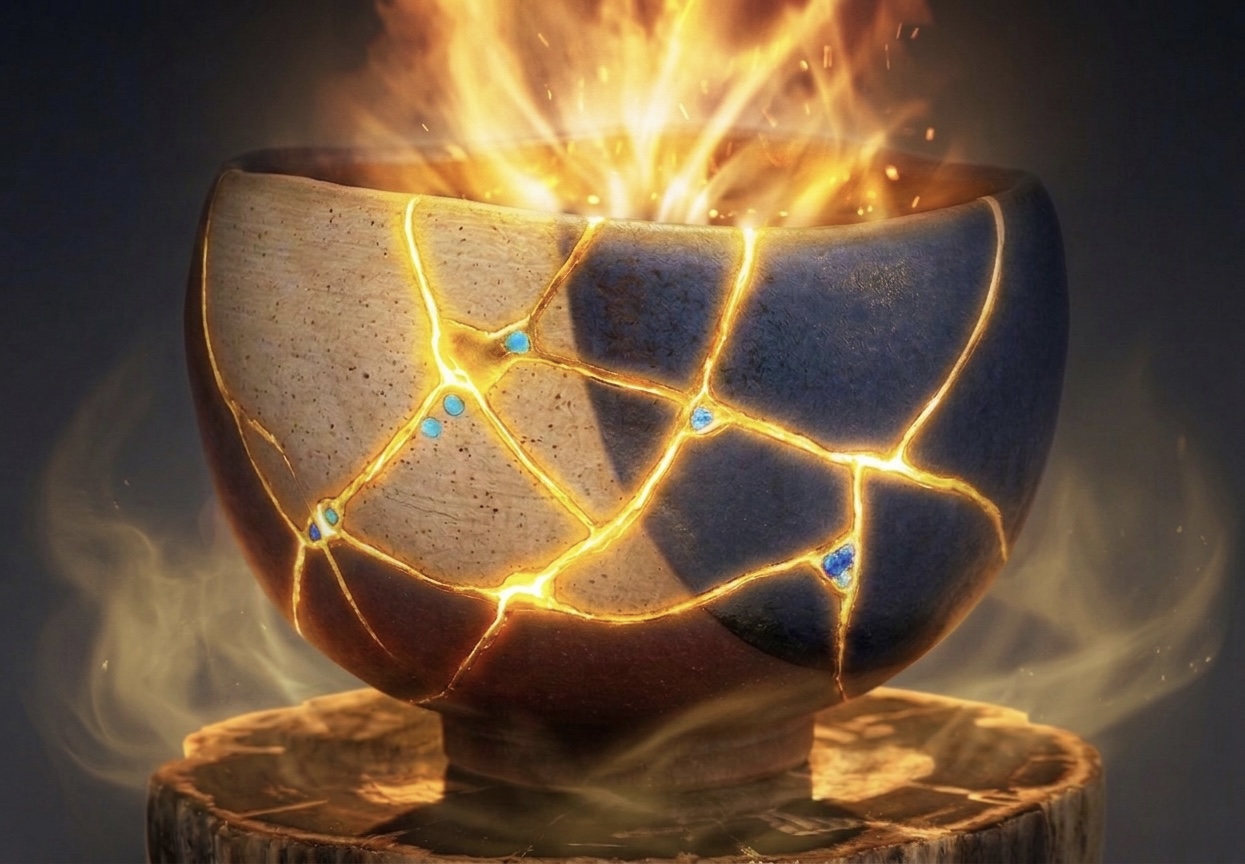
Look at the vessel one more time.
Every golden seam is a place where something shattered. And every golden seam is the place where light enters now.
The psalm says: “I have become like a broken vessel.”
The hymn says: Kenosis. The vessel chose to break so that what was inside could reach the world.
And then: Therefore.
Because of the breaking, not despite it. Therefore your brokenness is not the end of the story.
It is the opening.
A Prayer
God of the broken vessel, we come before you with clenched hands and fractured hearts. We have tried to hold ourselves together, and we are tired.
We confess that we have feared our own brokenness—believed it meant we were finished, discarded, beyond your reach.
Teach us the kenosis. Teach us to unclench. Show us that what we have gripped so tightly was never ours to hold—and that the release is not loss but the beginning of being found.
Pour your gold into our cracks. Make the broken places luminous. Transform our suffering into the channel through which your love reaches the world.
In the name of the one who emptied himself, who was broken for us, and whose wounds still shine. Amen.