
“The Mandate to Love”
The word Maundy comes from the Latin mandatum—commandment. This night is named for an order. Not a suggestion. Not an invitation to consider. A mandate, given in an upper room on the last night before the cross. We gather tonight to hear what was commanded—and to ask whether we understand what we have been told to do.
The disciples have gathered for Passover, the feast that remembers slavery escaped and freedom won. But Jesus knows something they do not. He knows the hour has come. He knows that within hours he will hang on a cross. And in that knowledge—in the full consciousness of his identity and his destination—he does something that should never happen.
“Jesus, knowing that the Father had given all things into his hands, and that he had come from God and was going to God, got up from the table, took off his outer robe, and tied a towel around himself. Then he poured water into a basin and began to wash the disciples’ feet.” John 13:3–5 (NRSV)
The Greek word matters. John says Jesus is giving them a hypodeigma—not a moral lesson or an inspiration but a pattern to be copied, a form to be replicated. The one who holds all authority is showing them the shape that authority takes in his kingdom. It is the shape of a servant on their knees.
Peter resists. You will never wash my feet. And there is something beautiful in that—not arrogance but loyalty, an intuition that the Lord should not be at the feet of his disciples. But Jesus says: Unless I wash you, you have no share in me. To belong to his kingdom is to accept that power, when it encounters love, chooses to kneel.
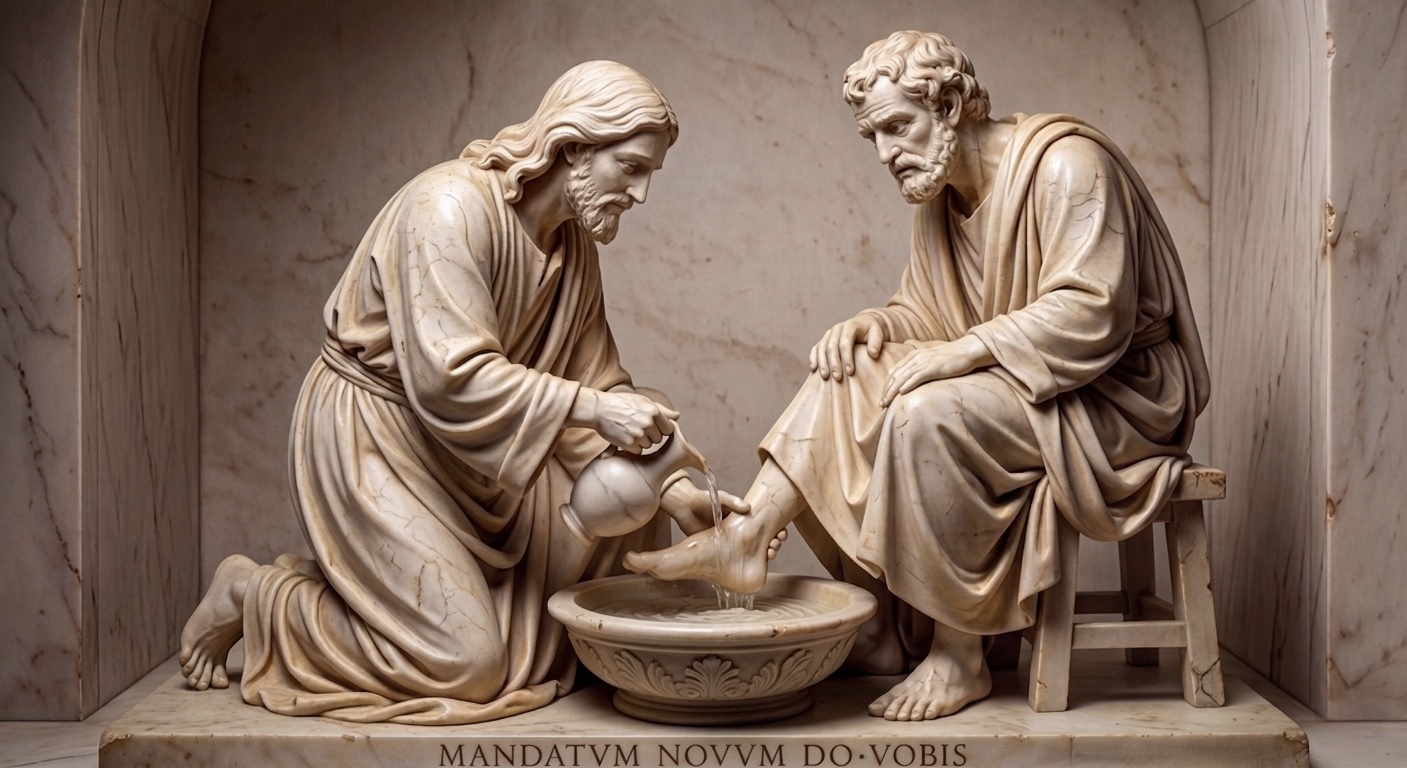
Then the new commandment comes. Not a modification of the old law. Not a clarification of what love has always meant. New.
“I give you a new commandment, that you love one another. Just as I have loved you, you also should love one another. By this everyone will know that you are my disciples, if you have love for one another.” John 13:34–35 (NRSV)
The measure is the as—just as I have loved you. Not the love we find easy or natural. The love that empties itself. The love that kneels. The love that goes to a cross. The commandment is new because it is measured by something that has never happened before—the self-giving of God in the flesh.
This is the mark of discipleship. Not what you believe. Not the doctrines you recite. The world will know we are his followers by whether our love costs us something. By whether we have learned to love as he loved—cruciform, poured out, asking nothing in return.
In a moment we will gather around this table. We will break bread and share the cup. But do not let the towel and the basin disappear from this meal. The bread is his body broken. The cup is his blood spilled. This table only means what the foot washing meant—love poured out, knees on the floor. The mandate stands.
Will we answer it? Not someday. Not when love is easy. Now—with our neighbors, with those who oppose us, with those we are called to forgive. Will we love as we have been loved?
A Prayer
Lord Jesus, we see you on your knees tonight, towel in hand, and we are ashamed of how little our love looks like yours. But we do not come to condemn ourselves. We come to receive the pattern—a love that serves, a power that kneels, a kingdom built on the willingness to empty ourselves for another.
Teach us to love as you have loved us. Not in grand gestures alone but in the daily work of forgiveness, in the steady presence with those who suffer. Make us disciples known by our love.
And tonight, as we eat and drink, remind us: you are present. You are breaking yourself for us, still. Help us to do the same for one another. Amen.