
“The Easy Yoke”
The Children Who Will Not Play
Jesus looks at his own generation and reaches for the image of children who refuse to play. They are like children in the marketplace, he says, calling to one another, “We played the flute for you, and you did not dance; we wailed, and you did not mourn.” Two games are on offer — a wedding game with glad music, a funeral game with mourning — and there is a child in the corner who will join neither. Nothing pleases.
That, Jesus says, is this generation. John the Baptist came as a stern ascetic, living on locusts in the wilderness, and they said he had a demon. The Son of Man came feasting, eating and drinking at the tables of sinners, and they called him a glutton and a drunkard. John wailed and they would not mourn; Jesus piped and they would not dance. The deeper trouble was that they had already resolved not to be reached — there was no version of God’s messenger they were willing to receive. Yet wisdom is vindicated by her deeds: the messengers would be proven right not by winning the argument but by the fruit of what they did.
Hidden From the Wise, Revealed to Infants

Out of that rejection Jesus prays aloud, and the prayer turns the world’s hierarchy over.
“I thank you, Father, Lord of heaven and earth, because you have hidden these things from the wise and the intelligent and have revealed them to infants.”Matthew 11:25 (NRSV)
The wise and the intelligent are the marketplace critics — the people with the training and the settled opinions, who knew too much to be surprised by God. The things of the kingdom were hidden from them, not because God is stingy but because their hands were already full; a gift cannot be received by fists clenched around their own certainty. The same truth was revealed to infants — nēpioi, the little children, the simple and unguarded, those with nothing to defend and everything to receive. It is one of the deepest patterns in the Gospel: the kingdom is not won by being clever or impressive enough but received the way a child receives, with open and empty hands. The door into everything Jesus is about to offer opens only one way — by stopping the performance and simply coming.
Between the thanksgiving and the invitation Jesus says something that binds them together: All things have been handed over to me by my Father; and no one knows the Son except the Father, and no one knows the Father except the Son and anyone to whom the Son chooses to reveal him (Matthew 11:27). The rest he is about to offer is not a technique or a teaching; it is the Son himself, and through him a Father no one could otherwise reach. To come to Jesus weary is to be let in on the oldest, deepest knowing there is.
Come to Me
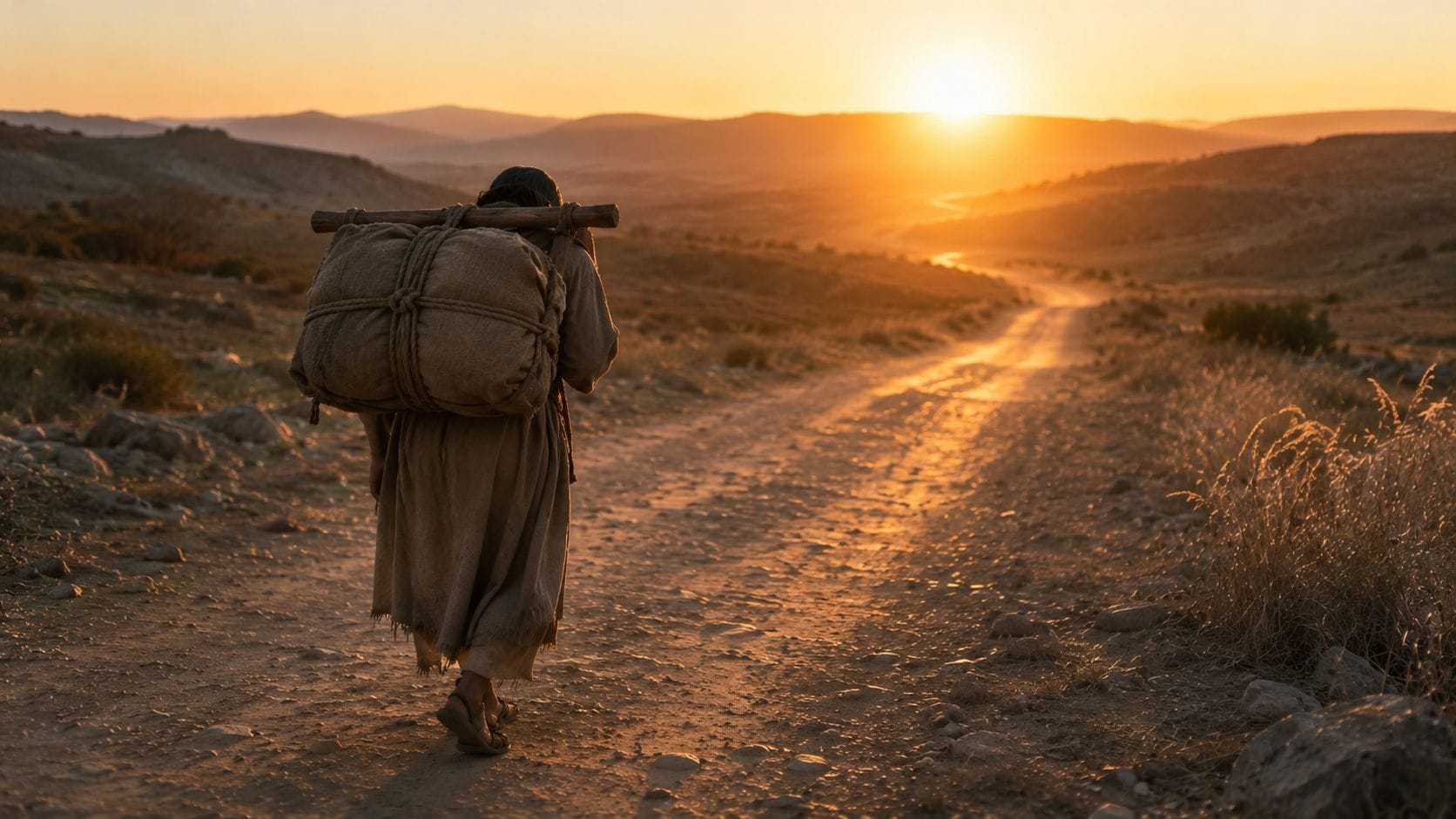
And then he says it — the most welcoming sentence in all of Scripture.
“Come to me, all you that are weary and are carrying heavy burdens, and I will give you rest.”Matthew 11:28 (NRSV)
Look at who is invited: not the rested, not the strong, not those who have their lives in order, but the weary and the heavy-laden — the worn out, the worn down, the ones dragging a weight they can no longer carry. The first word names the exhaustion of hard labor; the second pictures a pack animal loaded past what it can bear. Some of that weight is the weight of living — grief, illness, fear, the sheer grind of getting through. Some of it, in Jesus’ day, was the weight religion itself had piled on, the heavy burdens its experts tied onto people’s shoulders and would not lift a finger to move (Matthew 23:4). To all of them Jesus says one word — come — and makes one promise — I will give you rest. He does not say try harder, or clean yourself up first. He says come while still weary, come while still carrying it. The rest is not earned at the top of a long climb; it is a Person to fall toward, exhausted, at the beginning.
The Yoke That Fits

What he offers next sounds at first like a contradiction. He has just promised rest, and now he holds out a yoke.
“Take my yoke upon you, and learn from me; for I am gentle and humble in heart, and you will find rest for your souls. For my yoke is easy, and my burden is light.”Matthew 11:29–30 (NRSV)
A yoke is the wooden beam laid across an ox’s shoulders to harness it for work; how is that rest? The surprise hidden in the picture is that Jesus does not offer a life with no yoke at all, because there is no such life. Everyone is yoked to something — to ambition, to fear, to the relentless project of proving oneself, to the expectations of a generation that is never satisfied. The question is never whether a person will carry a yoke but whose. Trade the one that is grinding you down, Jesus says, for mine, because mine is easy — and the word means well-fitting, kindly, shaped to suit, like a yoke a careful carpenter has sanded smooth to the exact curve of the shoulders so that it does not chafe. A yoke that fits is not a burden; it is what makes the load bearable.
And there is a further mercy in the image. A yoke in that world was often built for two, two animals side by side sharing the weight, the stronger bearing the greater share. To take Christ’s yoke is not to be handed a load and left; it is to find him already in the harness. Learn from me, he says — not learn about me, but learn from me, walking alongside. And he names the one thing he wants known about the heart one will be walking beside: I am gentle and humble in heart. It is the only place in the four Gospels where Jesus describes his own heart, and the word he chooses is gentle, lowly. The Lord of heaven and earth, to whom the Father has handed all things, stoops into the yoke beside the weariest people in the marketplace and pulls. That is why the burden is light — not because it weighs nothing, but because it is no longer carried alone. The rest for the soul that the prophet once told Israel to seek along the ancient paths (Jeremiah 6:16) turns out, in the end, to have a face.
A Closing Prayer
Lord Jesus, gentle and humble in heart, you did not wait for us to be strong before you called us; you said come while we were still weary, still carrying more than we could bear. Take from our shoulders the yokes we were never meant to wear — the proving, the fearing, the endless dissatisfaction of a heart that will not be pleased — and fit us instead to yours. Teach us to walk beside you, learning your gentleness, sharing the load that is somehow light; and to everyone tired in ways no one else can see, give your rest, deep in the soul, today.