
“Let Both Grow Together”
Nobody Did Anything Wrong
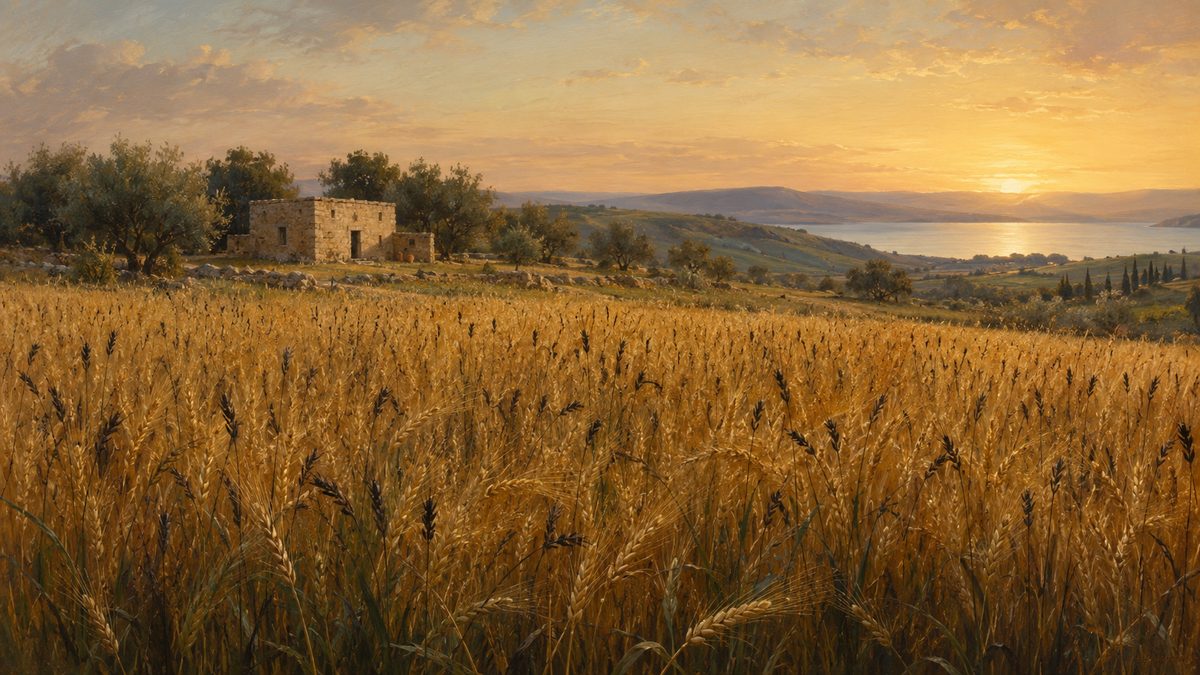
The field is good and the seed is good, and the parable insists on both before it says anything else. A landowner sows good seed in a field that belongs to him, and the sowing is done well. Then night comes, as night does, and the household sleeps, as households do. Somewhere in that ordinary darkness a man walks onto the land, scatters darnel through the young wheat, and walks away. He gets one sentence in the story. He comes, he sows, he goes — and he never returns to gloat, to argue, or to contest the harvest. One night is all he is given.
The sleeping is not the sin. The parable never says the workers were careless or the master distracted. It says it was night, and people sleep at night. Nobody failed. And for weeks nothing shows, because darnel is a nearly perfect counterfeit — blade for blade, green for green, it comes up indistinguishable from the crop it imitates. Only when the heads form does it declare itself: black and small where the wheat is golden and full.
So it is deep into the summer before the workers come up the road with a question. The question is older than the field.
An Enemy Has Done This
“Master, did you not sow good seed in your field? Where, then, did these weeds come from?”Matthew 13:27 (NRSV)
That is theodicy in work clothes — the question anyone asks standing in the middle of a life they did not plan: you are good, and this is yours; so why does it look like this?
The answer is four words. “An enemy has done this.”
It is worth sitting with how little that explains. No investigation. No theory. No astonishment. The master does not say the weeds are part of a plan, or a lesson, or a punishment, or a mystery too deep to be spoken. He names an agent, and he stops. And in stopping he says two things at once to anyone who has ever found something growing in their life they never planted — the addiction, the diagnosis, the thing done to them when they were fifteen: that was not me, and that is not the end of this.
Then the workers make their offer, and the parable sets its hook. “Then do you want us to go and gather them?”
It matters who is speaking. These are not cynics. They are loyal. They are right about the weeds — there really are weeds, and darnel is genuinely poisonous. And they are volunteering for hot, unpaid, back-breaking work in a field that is not even theirs. Everything that is wrong with them is admirable.
And he says no.
The Braided Roots
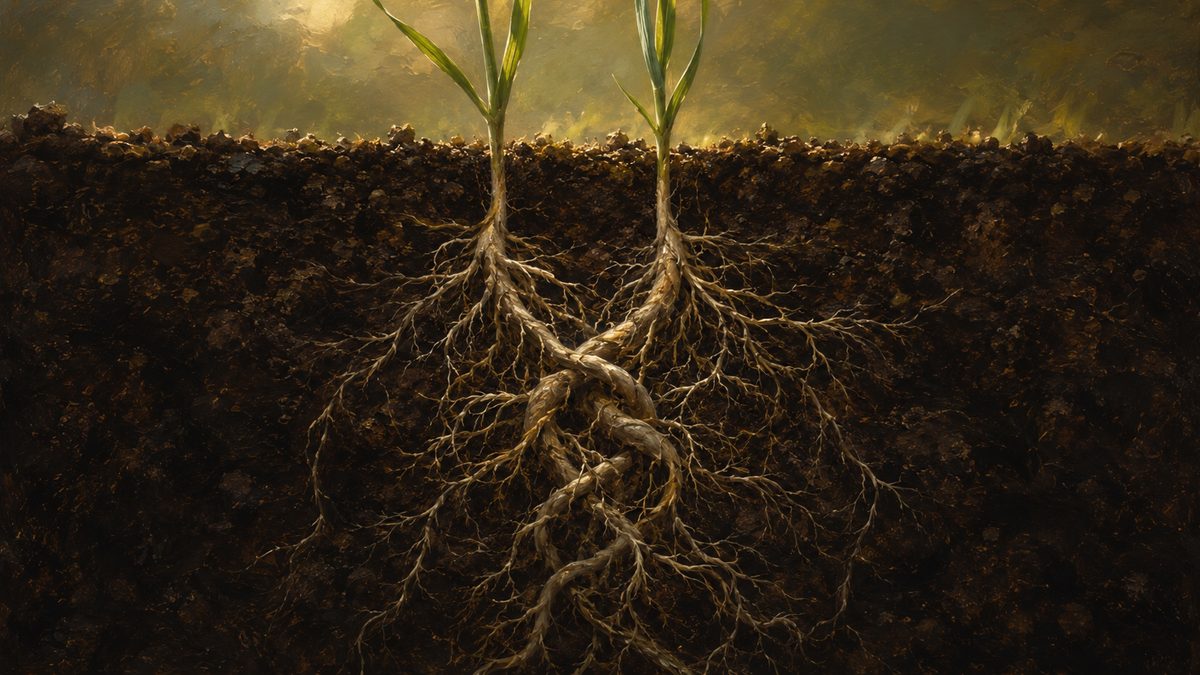
The reason is not the one anyone expects. He does not say the weeds are harmless. He does not say the servants have misjudged them. He does not say that darnel, given time enough, turns into wheat.
“No; for in gathering the weeds you would uproot the wheat along with them.”Matthew 13:29 (NRSV)
Underground, the roots are braided together — darnel root and wheat root wound around each other in the dark, gripping so tightly that no hand can pull the one without tearing the other. The master’s objection is not that the weeds deserve better. It is that the wheat will not survive the weeding.
That is a harder sentence than “God is patient with everybody,” and a better one. It is not a story about tolerance. It is a story about an owner who counted what a purge would cost and decided it costs less to let the darnel stand than to lose the crop he loves.
And there is a second thing underneath his no: the servants could not have done it anyway. Not honestly. In June the two crops are indistinguishable — that is darnel’s whole nature — so the problem was never the servants’ loyalty. It was their confidence. They were certain they could tell. Looking at a field in June, nobody can.
That mercy runs in two directions, and the second is the one that catches people off guard. No one can finally classify the person across the aisle, or across the years. No one can finally classify himself, either — and the person most likely to be tearing out wheat is the one doing it at three in the morning, to himself, certain he is darnel.
That reading was never his to make. The psalmist appointed for the day knew it. He does not say I will sort out my heart. He asks for the sorting to be done to him, and by someone else.
“Teach me your way, O Lord, that I may walk in your truth; give me an undivided heart to revere your name.”Psalm 86:11 (NRSV)
Unite what is not one. He asks. He does not reach for a hoe.
And then the master says the thing that is easy to read past.
“Let both of them grow together until the harvest; and at harvest time I will tell the reapers.”Matthew 13:30 (NRSV)
The reapers. Not the servants. The workforce changes at harvest — the people who tend the field are not the people who sort it.
Shining Like the Sun

The story does not end soft. There is a furnace in it, and weeping, and gnashing of teeth. There is a sorting, and it is real. But it is worth noticing where that fire sits in the logic. The reason the servants can put the hoe down is that the reapers are coming. Take away the harvest and their proposal becomes reasonable again — somebody has to sort this out, and if not God, then the servants, tonight, with whatever tools are at hand. The furnace in verse 42 is the reason there is no hoe in verse 29. The ledger can be set down — not because it does not matter, but because it is being kept by someone with better eyes and a better right.
And Jesus does not stop at the fire. “Then the righteous will shine like the sun in the kingdom of their Father.” It is Daniel’s ancient promise — and it is, four chapters later and on a mountain, exactly what Matthew will say of the face of Jesus: his face shone like the sun. So the harvest is not, at bottom, about the disposal of darnel. It is the morning when what has been true underground finally becomes visible — and what it looks like is the face of Christ.
A pastor in Roswell, New Mexico knows that waiting from the inside. Years ago he asked God for something plainly — a good thing, he was sure of it — and for a long while the answer was only silence. Silence is fertile ground; it grows its own weeds, and his were the small green shoots of he isn’t listening, he doesn’t care. It took him years to learn that no answer can itself be an answer — that what he had begged for was not the best thing, and that the God who kept saying not this was not neglecting him, but keeping him from something he could not yet see under the surface. He only knows that now, looking back.
Paul says the same, and says why it cannot be seen from inside. The whole creation, he writes, is craning its neck for “the revealing of the children of God.” And then he names the shape of the waiting.
“Now hope that is seen is not hope. For who hopes for what is seen? But if we hope for what we do not see, we wait for it with patience.”Romans 8:24–25 (NRSV)
The wheat looks like darnel in June for the same reason a promise is invisible from inside the season. That is not a defect in the field. That is what growing is.
A Closing Prayer
God who is slow to anger, we have been sorting a field that was never ours. Forgive us the hoe — the verdicts we have handed our neighbors, and the harder ones we hand ourselves at three in the morning. Thank you for a no that was spoken to protect us, and for a harvest we do not have to bring in. Unite our divided hearts. Keep our hands off the field. And hold us through this long green season until the morning you have promised, when the wheat is gathered in and the righteous shine like the sun. Amen.