
“Both Ways”
Eight Words
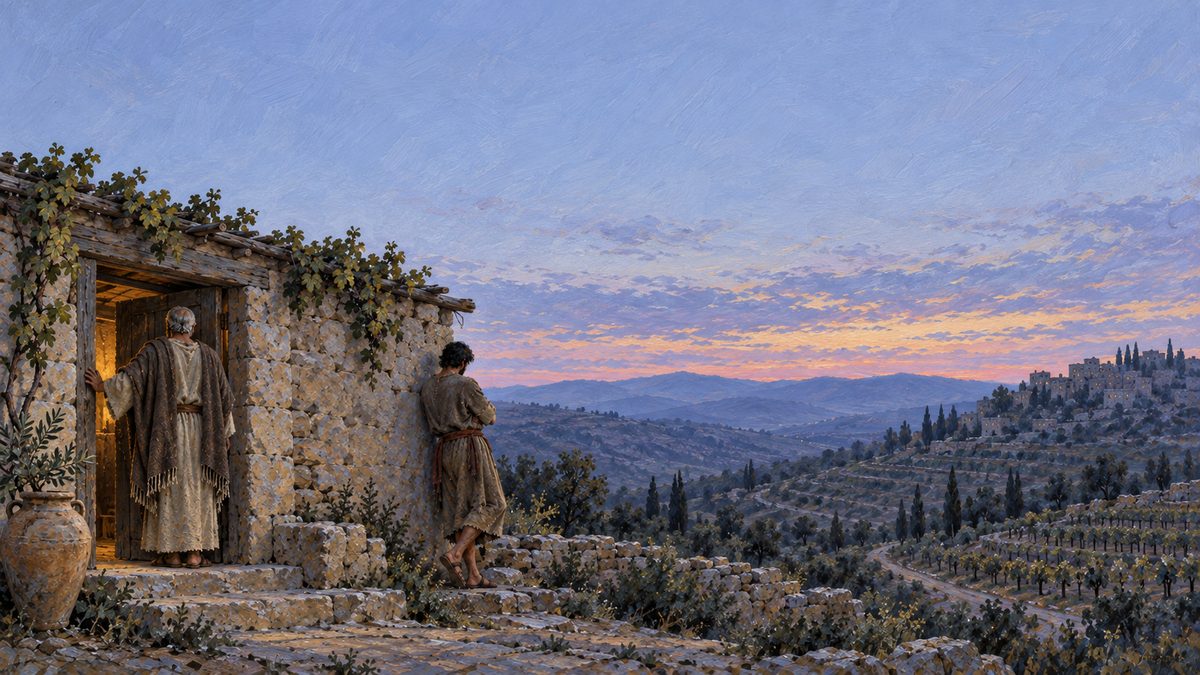
A father goes out to his son on an ordinary morning and says eight words.
“Child, go and work in the vineyard today.”Matthew 21:28 (NRSV)
He does not say what the day is worth. No wage, no term, no bonus for finishing early. There is a vineyard, a day, and the word go.
Here is what it is about instead, and it can be said at the door rather than saved for the end. Every covenant goes both ways. If you do this, then I will do this — that is the shape of every promise ever made between two parties, and it is the shape of the promise between God and us. One side has already been kept. The house is built, the vineyard is planted, the day has been given, and the father has come out himself to ask. What is left is the son’s half — and the son’s half is not a feeling. It is a walk down a road.
Two Ways of Not Answering
Look first at the men Jesus is talking to, because the parable is his reply to them.
The chief priests and elders come to him in the temple while he is teaching: By what authority are you doing these things, and who gave you this authority? It is a credential question, and Jesus asks one question back: John’s baptism, from heaven, or of human origin? Matthew then prints their private deliberation: If we say, “From heaven,” he will say to us, “Why then did you not believe him?” But if we say, “Of human origin,” we are afraid of the crowd. Two answers, weighed by what each would cost them. Not one clause about whether it was true. So they give the safest sentence in the temple: We do not know.
The story he tells them in reply is four sentences long. A man had two sons. He went to the first and said, Child, go and work in the vineyard today; the boy said I will not, and later changed his mind and went. He went to the second, who said I go, sir, and did not go. Which of the two did the will of his father? They answer correctly: The first.
Hold that beside the second son. I go, sir — the right word, respectfully given, and Matthew has been warning about that word since the Sermon on the Mount: Not everyone who says to me, “Lord, Lord,” will enter the kingdom of heaven, but only the one who does the will of my Father in heaven. Keep the two answers side by side; the ending will come back to them.
A covenant that goes one way is not a covenant. It is a courtesy — and courtesy, however correct, has never yet put anyone in a vineyard.
Three Who Knew the Cost

Scripture is full of people who stepped in, and it is worth noticing what they have in common: not one of them went eagerly.
Abraham was told to take his son, his only son, whom he loved, up a mountain and offer him there. He had every reason to refuse, and the text records no speech of consent, only that he rose early in the morning and went. What God wanted on that mountain turned out not to be the sacrifice at all; there was a ram in the thicket. What God wanted was the trust, and Abraham’s trust was the going.
Jacob, alone at the river in the dark, wrestled until daybreak and would not let go: I will not let you go, unless you bless me. He got the blessing, and he limped for the rest of his life. The blessing was real, and so was the cost.
And Matthew, at his tax booth, with a living and a position and every reason to stay seated, got up and followed. Four verses later, at the dinner that followed in Matthew’s house, Jesus says the sentence that explains all three of them.
“I desire mercy, not sacrifice.”Matthew 9:13 (NRSV)
None of them went with desire, and none of them went absent-mindedly. They knew what they were giving up and what they were risking. They went because they trusted the One who gives the blessing — the One who takes no pleasure in our sacrifice, and who asks of us only a heart that is open toward him and sincere.
Now read the first son again. I will not — in Greek, I do not will it. There was no desire in him, and the parable never calls his refusal brave. But later he changed his mind and went. And the praise he is given is not for passion. It is for an obedient heart, and for the trust underneath it that his father is just and faithful — that a day asked for by this father is a day worth giving. The son who went was the son who did not want to go, and he went on trust alone.
What God Wants, and What God Does
So what does the covenant ask of us? The psalm for this Sunday says it in one line: O my God, in you I trust. Not a passion for the work. Not a performance. A heart that is open and does not hide, and a willingness to be led — he leads the humble in what is right, and teaches the humble his way.
And Scripture is honest about where even that comes from. Paul writes to a church he loves:
“work out your own salvation with fear and trembling; for it is God who is at work in you, enabling you both to will and to work for his good pleasure.”Philippians 2:12–13 (NRSV)
Both. The going, and the willing that was missing in the first son and arrived anyway. The trust is ours to give, and it is also God’s gift to us — that is what it means for a covenant to go both ways.
Then the hard part, because it is real. Some of the time, and for some of us most of the time, what God asks does not look reasonable. It did not look reasonable to Abraham. The exiles in Ezekiel’s day said it out loud: The way of the Lord is unfair — in Hebrew, the way of the Lord does not weigh right, a merchant’s complaint about the scale. God does not produce better figures. God takes the scale away — Know that all lives are mine — and the prophet Isaiah says the rest: my ways are higher than your ways. Not heavier on one side. Higher than the scale.
That is the trust the covenant asks for when the instruction does not add up: that God is the source of wisdom and of life, that he keeps his promises, and that he makes the best of whatever we bring.
The Third Son

Now put the men in the temple and the son at the door side by side, because Jesus did. The chief priests and the elders had everything a covenant partner is supposed to have — the standing, the vocabulary, the building itself. They asked who gave you this authority, and when the one question came back that would have obliged them to act on the answer, they weighed it, found it too expensive, and said the safest thing. The second son had everything too — the father’s ear, the right honorific, a prompt and courteous yes — and then he weighed the day, found it too expensive, and stayed where he was.
Neither of them ever said no. That is the point. Both gave the answer that keeps the relationship on paper and costs nothing in the vineyard: we do not know and I go, sir are the same sentence in different clothes. Both wanted the standing of a covenant without the participation of one — and a covenant, remember, goes both ways. So Jesus sets against them the people who had no standing at all. The tax collectors and the prostitutes heard John and went: they are going into the kingdom of God ahead of you. Not the ones who answered best. The ones who moved.
Here is where that lands in an ordinary week. Most of us are not tempted to say I will not to God. We are tempted to say I go, sir. We say it to the need read out on a Sunday that we mean to meet and do not; to the call we have promised to make; to the apology we have agreed we owe; to the word of faith we intend to speak to someone and keep postponing. And when the question comes that would require us to act on what we already know — to forgive that person, to make that visit, to say what is true when the room would rather we did not — we do what the men in the temple did: we weigh what it will cost us, and we say I am not sure. The teaching of Jesus is not that we should feel worse about this. It is that a covenant has two sides, and ours is not a sentence. It is one day, one act, one walk to the vineyard, taken on trust that the father who asked is just and faithful and will make the best of what we bring, however late and however unwilling. So take the one yes you have already given and not yet kept, and keep it. That is the whole of the lesson, and it is enough.
And the covenant was kept from God’s side first, by a third son.
In the hymn Paul quotes to the Philippians, Christ did not regard equality with God as something to be exploited, but emptied himself … and became obedient to the point of death. Here is the son who said yes and went — all the way. The word for equality is the very word the laborers used one Sunday ago, you have made them equal to us: what they clutched at, he let go. And the hymn does not stop at the emptying. Therefore God also highly exalted him. God’s side, kept before and kept after.
So the door is not closed on anyone who said no — or on anyone who said yes and stayed. Ahead of you is not instead of you; it is a procession you are still in. And the prophet’s last word to the people who were sure God’s scales were wrong was not a verdict. It was an invitation with a date on it: Turn, then, and live.
If you said no — years ago and meant it, or this morning — or said yes and never went, the father is still coming out to ask. The covenant still has your name on the other side of it. And it is not someday. It is today.
You are seen. You are loved. And grace has not finished with you yet.
A Closing Prayer
Faithful God, you have kept your side of every promise you ever made to us, and we have so often answered you with the right words and stayed where we were. Give us hearts that are open toward you and sincere. When your way does not add up to us, remind us that it is higher than our scales, and that you take no pleasure in our sacrifice but only in our trust. Work in us the willing, and then the going; and for every one of us who has said no, give us a later, and let it come today.
In the name of the Father, and of the Son, and of the Holy Spirit. Amen.