
“The Garment Is Given”
One More Parable
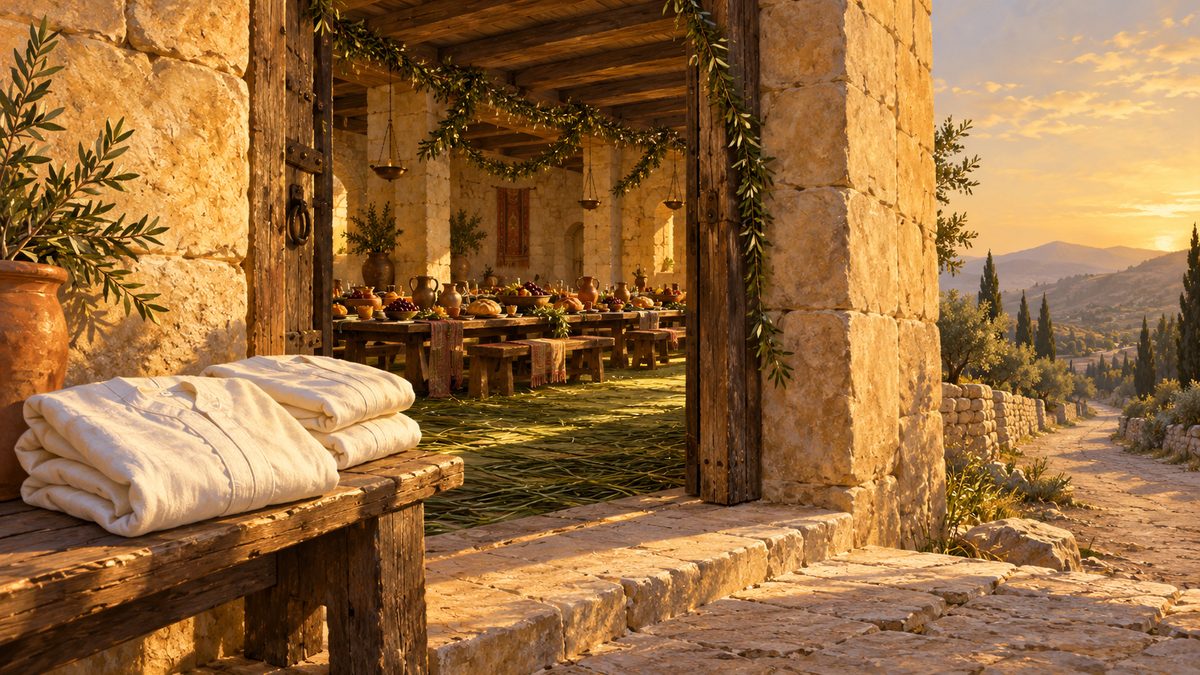
One more parable, on the same Tuesday, to the same men — and this time the story turns over.
For two Sundays the parables in that temple courtyard have been about losing something. A son who said I go, sir, and did not go. Tenants who worked a vineyard so long they forgot it was not theirs. Both stories ended with something taken away and handed to someone else.
Then Jesus speaks again, and the first sentence is about a party.
“Once more Jesus spoke to them in parables, saying: ‘The kingdom of heaven may be compared to a king who gave a wedding banquet for his son.’”Matthew 22:1–2 (NRSV)
Notice what the kingdom is compared to: not a feast, not a guest list, but a king who does something — a father throwing a wedding for his boy. And notice whose wedding it is. In the story just finished, the owner’s son was thrown out of the vineyard and killed. Now, with hardly a breath between them, the kingdom of heaven looks like that son’s wedding.
The son they threw out is the son whose wedding this is. That is the gospel folded small.
Everything that matters in this parable is something the king does. He makes the feast. He sends, and sends again. He fills the hall. And — this is where we will end — he clothes his guests. The story has hard things in it, but it begins by telling us what God is doing with the world: throwing a wedding for his Son, and meaning for the room to be full.
The Ones Who Had Already Said Yes
Nobody in this story is being asked out of the blue.
In that world a great feast was announced twice. Weeks ahead, a messenger brought the invitation, and you accepted or declined. Then on the day itself, when the animals were slaughtered and the bread was baked, a second messenger came with one word: now. Matthew’s Greek keeps the custom in a phrase English smooths away — the king sends his slaves to call the ones who had been called. These people had already said yes.
So what happens next is not an invitation turned down. It is a promise quietly dropped.
The king does not accept that as the last word. He sends again, and this time the message is almost tender in its detail: Look, I have prepared my dinner, my oxen and my fat calves have been slaughtered, and everything is ready; come to the wedding banquet. Three verbs in that sentence stand in the Greek perfect tense — prepared, slaughtered, ready: finished action, with its result still standing. Nothing about this feast waits on the guests. It is done before they are asked. Even the menu is Isaiah’s — rich food filled with marrow — an old promise set on the table.
And then:
But they made light of it and went away, one to his farm, another to his business.
They made light of it. The Greek word means they could not be bothered. It is not hostility; nobody argues with the messenger. There is a shrug, and a turn toward something more pressing. And look where they go: one to his own farm, another to his business. Land and trade — the two things anyone in that world would have called a decent, responsible life. Neither man does anything wrong. A field has to be worked. A business does not run itself.
That is why this is the verse that comes nearest to Roswell. Hardly anyone here will spend this week refusing God. What most of us will do is go to the farm — the schedule, the house, the job, the appointments, the grandchildren, the hundred good things that are honestly ours to tend. Nobody decides to drop a promise like that. You get busy, and the second messenger arrives on a day when you have somewhere else to be.
Matthew hangs this whole stretch of his Gospel on one small verb of the will: the son who said I will not; the guests who would not come; and, two chapters later, Jesus over the city — you were not willing. Not could not. Would not. Grace in this story never runs short of supply. What runs short is wanting.
And notice the king’s first answer to indifference. It is not an army. It is another invitation.
A Hall Full of Strangers
Some of the invited do worse than ignore the summons. They seize the king’s slaves, mistreat them, and kill them, and the parable turns suddenly dark:
The king was enraged. He sent his troops, destroyed those murderers, and burned their city.
This needs saying plainly, because silence here is also a choice. This verse has been used for centuries to justify terrible things against Jewish people, and that use is a lie about the text. The one telling this story is a Jewish teacher speaking about his own city in the voice of his own prophets, who said hard things about Jerusalem because they loved her. And when Jesus finishes speaking in that temple, he ends not with a verdict but with a lament — a hen longing to gather her brood under her wings.
Read, too, exactly who is destroyed: those murderers. Not the man who went to his farm. The parable does not burn the city of the distracted. It is hard enough without our making it harder than it is.
Then comes the sentence that should never stop astonishing us:
“Go therefore into the main streets, and invite everyone you find to the wedding banquet. Those slaves went out into the streets and gathered all whom they found, both good and bad; so the wedding hall was filled with guests.”Matthew 22:9–10 (NRSV)
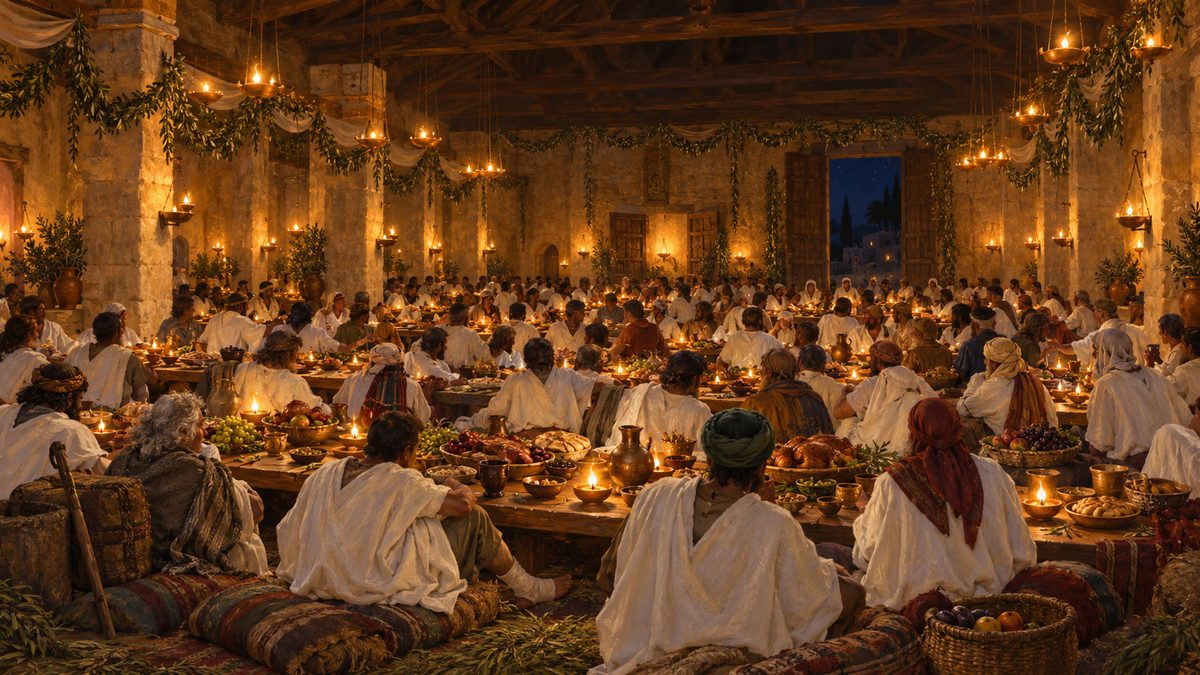
The word behind main streets means the places where the roads run out of town — the crossings, the edges, wherever people stand who are on nobody’s list. And in Matthew’s Greek the order is bad and good. Bad comes first.
Jesus drew this picture once before, with a net that caught fish of every kind; the sorting comes later, and it is not the fishermen’s job. The king’s slaves check no one’s record at the door. They were told to fill a hall, and they fill it.
Anyone who has ever sat in a pew doing quiet arithmetic about whether they belong there can put the pencil down. Nobody in that hall qualified. The room was filled with people who happened to be standing near a road when someone came running with an invitation. That is the guest list. It has always been the guest list.
And it is not God’s second idea. Isaiah saw it centuries earlier: On this mountain the LORD of hosts will make for all peoples a feast. For all peoples. The slaves running to the crossroads are not a backup plan after the first guests failed. They are the first plan, finally arriving. The king never stopped wanting the ones who would not come; he simply refused to let their absence empty his Son’s wedding.
The Man Without a Garment
And just when the story could end with a full hall and a glad king, it does something nobody wants it to do.
“But when the king came in to see the guests, he noticed a man there who was not wearing a wedding robe, and he said to him, ‘Friend, how did you get in here without a wedding robe?’ And he was speechless.”Matthew 22:11–12 (NRSV)
Our instinct is to defend him. He was swept in off a road; how was he supposed to own a wedding robe?
But read the scene slowly. The king calls him Friend — and in Matthew that word is never warm. Jesus will use it once more, in the garden, to Judas. It is how you address someone who had a place and let it go. And the king does not ask why are you dressed like that? He asks how did you get in here? — a question about belonging, put to a man who is plainly inside.
Then: he was speechless. The Greek is almost physical — he was muzzled, the word for a muzzle on an ox. He does not refuse to answer. He has no answer.
That silence is the key to the scene. A man who had been given nothing would have had everything to say: No one offered me anything. I came as I was, because that is how I was brought. He would have said it, he would have been right, and the story would have turned against the king. He is silent because something was waiting for him at the door, and he walked past it.
Across the whole of Scripture, the garment that matters is never brought from home. It is issued. Zechariah watched the high priest stand before God in filthy clothes and heard the command, Take off his filthy clothes, and then the promise, I will clothe you with festal apparel. Paul wrote, As many of you as were baptized into Christ have clothed yourselves with Christ. And at the very end of the Bible, at the marriage supper of the Lamb, the bride stands in fine linen, bright and pure — and the text stops to say that to her it has been granted to wear it.
Granted. Given. And then Revelation adds that the same linen is the righteous deeds of the saints. The garment is a gift, and it is also a life. It is handed to you at the door, and then you live in it.
That is about as Methodist as Scripture gets. In one of the last sermons he wrote, John Wesley took up this very robe: the righteousness of Christ is what gives anyone a place at the feast, and holiness — a heart and life made new — is what that gift looks like when it is actually worn. Not a costume you stitch yourself, and not a label you never put on. One grace, received and then lived.
So the second half of this parable is not a dress code. It is not about looking respectable for God, and any sermon that sends people home to tidy themselves up before they dare come to church has preached the opposite of what Jesus said. The robe was free. It was at the door. It was his. The only way to be found without one was to decline it on the way in — to want the party and refuse the host.
Even the last line — For many are called, but few are chosen — is not arithmetic about how many will be saved. It hangs by that small word for on this one man and his empty answer. Everyone in that hall had been called. The good and the bad, the strangers from the crossroads — every single one.
Two Garments
Put the two halves together and you get something neither soft nor cruel. The invitation is free and outrageous and indiscriminate — handed to whoever stands near the road, bad and good, no qualifications asked. And it is not nothing. Something was waiting at the door.
Listen once more to Isaiah, and to what God is doing on the mountain where that feast is spread:
“And he will destroy on this mountain the shroud that is cast over all peoples, the sheet that is spread over all nations; he will swallow up death forever. Then the Lord GOD will wipe away the tears from all faces.”Isaiah 25:7–8 (NRSV)
A shroud is a garment, too — the one the whole world has been wearing, the cloth laid over the face of the dead. These are words we read at gravesides, and some in this congregation have heard them read very recently. They are not read there as poetry. They are a promise about who God is. He does not loosen the shroud. He destroys it.

So the parable lands, at last, not on what we must do but on who God is. The God who walks that mountain pulling the burial cloth from the face of every nation is the same God standing at the door of his Son’s wedding with clean linen over his arm, for people who came in off the road with nothing.
He takes the death-clothes off the world. He puts the wedding clothes on us.
The feast is ready. The hall is full. The garment was given at the door, and it is already on your shoulders.
You are seen. You are loved. And grace has not finished with you yet.
A Closing Prayer
God of the feast, you prepared the table before any of us thought to come, and you sent to the edges of the roads to find us. We did not qualify, and still we are here. Forgive us the good and ordinary things that make us late to our own promises — the field, the shop, the crowded calendar. Thank you for the linen you laid on our shoulders at the door; teach us to live in it, until what you have given becomes the shape of our days. And when we stand at the graves of those we love, remind us that you are already pulling the shroud from the face of the world. Keep us at your Son’s table until the day you swallow up death forever and wipe the tears from every face.
In the name of the Father, and of the Son, and of the Holy Spirit. Amen.