
“The Vineyard Is Not Ours”
A Third Sunday in the Same Field
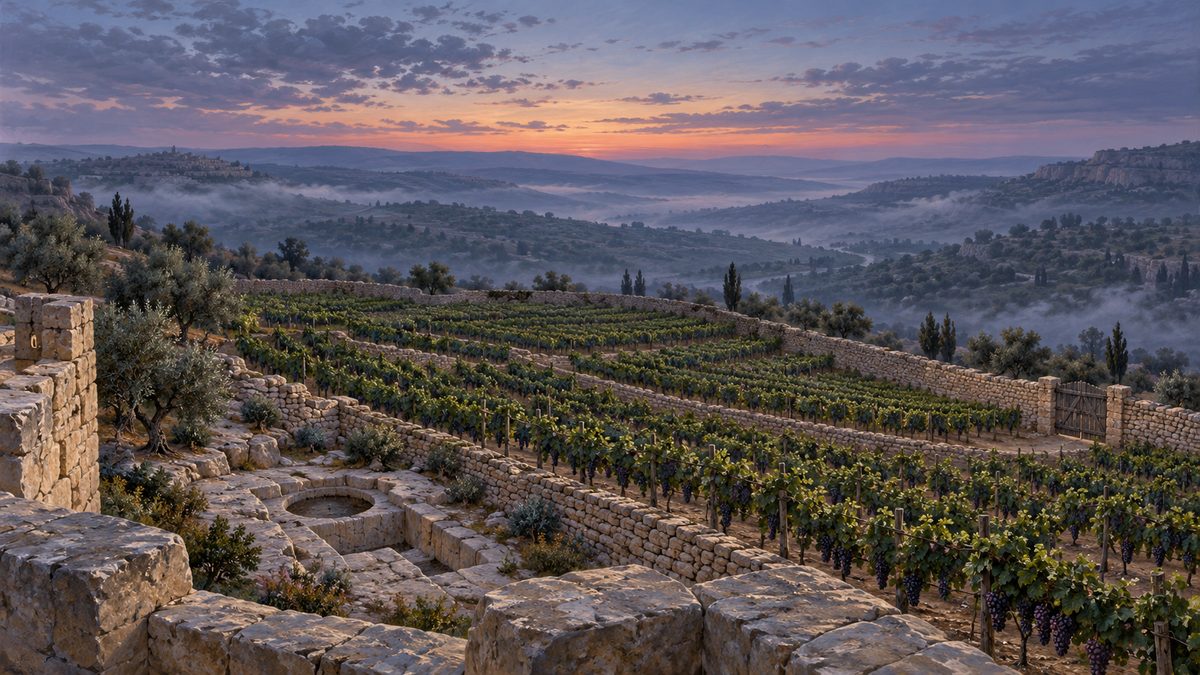
A third Sunday in the same field.
Two weeks ago it was a vineyard about wages, and the grievance was a sideways look down a pay line. Last week it was a vineyard about a day’s work, and nobody mentioned money at all. This week the vines and the wall and the tower are all still there, and the question has changed again, and it has gone underneath the other two.
Whose is it?
The parable answers at once and then spends itself on the answer. It was never theirs. They were handed the keys to a finished place — planted, fenced, towered, with the wine press already dug — and everything that went wrong went wrong inside that gift.
The Song They Could Finish
Jesus is still in the temple. It is the Tuesday of his last week, and the men in front of him are the same men who asked, an hour before, by what authority are you doing these things, and then said we do not know. He has told them one parable already. Now he says, Listen to another parable.
And the first sentence is not his.
“There was a landowner who planted a vineyard, put a fence around it, dug a wine press in it, and built a watchtower.”Matthew 21:33 (NRSV)
Anyone in that courtyard who had grown up hearing the prophets read could have finished the line, because it is Isaiah’s — the fence, the press, the tower. Isaiah sang it as a love song: Let me sing for my beloved my love-song concerning his vineyard. He listed the care item by item, and then the detail that gives the whole thing away: he hewed out a wine vat in it. A vat is not dug; it is cut into rock, and nobody cuts a vat into stone for a crop he is unsure of. Everything in that field was built on the expectation of a vintage.
So when Jesus opens with Isaiah’s lines, the men listening know exactly what kind of story they are inside, and they know how Isaiah’s ended: I will remove its hedge, and it shall be devoured; I will break down its wall, and it shall be trampled down. I will make it a waste.
Hold that ending in mind. What Jesus does with it is the most merciful thing in the passage, and it arrives disguised as a legal detail.
But notice, before the story goes on, that this owner is nothing like last week’s father at the door. He leased it to tenants and went to another country. He is a long way off, and what he does from there is send. At harvest he sends for his produce — not the vineyard back, not rent in silver, his share of the fruit, on the terms they had agreed to. It is a small ask, and the smallness of it is what makes what follows so strange.
What They Actually Wanted
They beat one servant, kill another, stone a third. He sends more, and the same thing happens. And then comes the tenderest and least reasonable sentence in the story: Finally he sent his son to them, saying, “They will respect my son.”
He is wrong, and he is wrong in the direction of hope. He assumes there is still something in them that shame can reach.
What is in them instead is a sentence the Bible has heard before. This is the heir; come, let us kill him and get his inheritance. In Greek the middle three words are lifted straight out of Genesis, from Joseph’s brothers watching him cross a field toward them — come now, let us kill him … and we shall see what will become of his dreams. The oldest murder plot in the family album, and it was always about the same thing. Kill the heir, and the inheritance changes hands.
Notice what the tenants are after. It is not the fruit; they have had the fruit all along. What they want is to stop being tenants. They want the deed. The whole crime is a change of legal status pursued with violence, and it was not even a foolish plan: under the usages of the day, land with no living claimant could well fall to the men in possession of it. The tenants are not monsters. They are reasonable people with a plausible strategy, which is what makes the story frightening.
So they seized him, threw him out of the vineyard, and killed him. Out first, then killed. Matthew puts the two actions in that order because that is where his readers know it happened — outside the wall.
Then Jesus stops the story and asks the audience to finish it. Now when the owner of the vineyard comes, what will he do to those tenants?
And they answer him. He will put those wretches to a miserable death, and lease the vineyard to other tenants who will give him the produce at the harvest time.
It is a polished sentence — in the Greek it has the ring of the courtroom — and it is their own sentence on themselves. This is Nathan standing before David with a story about a ewe lamb, except that nobody has to say You are the man! They have said it, out loud, in the temple, in front of a crowd.
It is worth stopping on that, because it is a warning about the way we listen. A room that agrees enthusiastically with a judgment is not the same as a room that is under it. The chief priests were never more certain, more articulate, or more wrong about their own position than at the moment they delivered that verdict.
Jesus adds no verdict of his own. He answers with a psalm, the one the crowd had sung to him on the road into the city: The stone that the builders rejected has become the cornerstone. In Hebrew stone and son are one letter apart: the son thrown out of the vineyard and the stone thrown off the building are the same rejection, and what was discarded is what everything now rests on.
But listen to the second half of what the men said, because they got it exactly right without meaning to. And lease the vineyard to other tenants.
Other tenants. Not other owners. Here is the mercy hidden in the legal detail: Isaiah’s vineyard was laid waste, and this one is not. The field is not burned and it is not given away. It is kept, and let again, on the same terms as before. Whoever comes next comes as a renter.
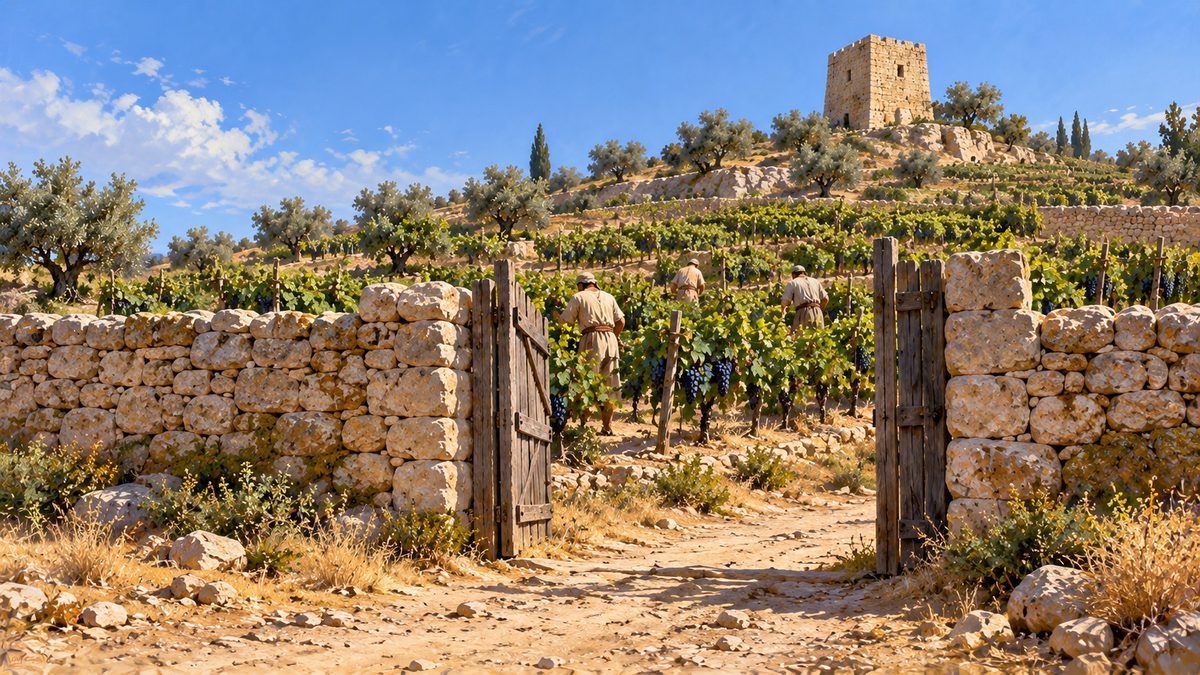
What the Crop Was Supposed to Be
Which leaves the question of what the owner was looking for in the first place — and here Isaiah has already answered, in a line that English cannot quite carry.
“He expected justice, but saw bloodshed; righteousness, but heard a cry!”Isaiah 5:7 (NRSV)
In Hebrew the two pairs are each one consonant apart: mishpat and mispach, tsedaqah and tseʿaqah. Say them aloud and the horror is in how nearly they match. The counterfeit sounds almost exactly like the real thing from any distance at all — which is precisely how a religious institution can be producing rot while singing on key.
So the fruit the owner came for has a name. It is not attendance, and it is not devotion, and it is not the correct answer to a question about authority. It is justice: the right of the poor honored, the honest weight, the cry that never should have had to be cried. Isaiah’s next paragraph, the one the lectionary leaves out, spells out the rot — you who join house to house, who add field to field, until there is room for no one but you; who acquit the guilty for a bribe.
That is the crop. That is what is supposed to leave the vineyard when the season comes.
And the psalm for this Sunday, where the vineyard itself gets to speak, prays for exactly that: have regard for this vine, the stock that your right hand planted. The vine does not pray to belong to someone else. It prays to be looked at again, and to bear.
A Field We Love and Do Not Own
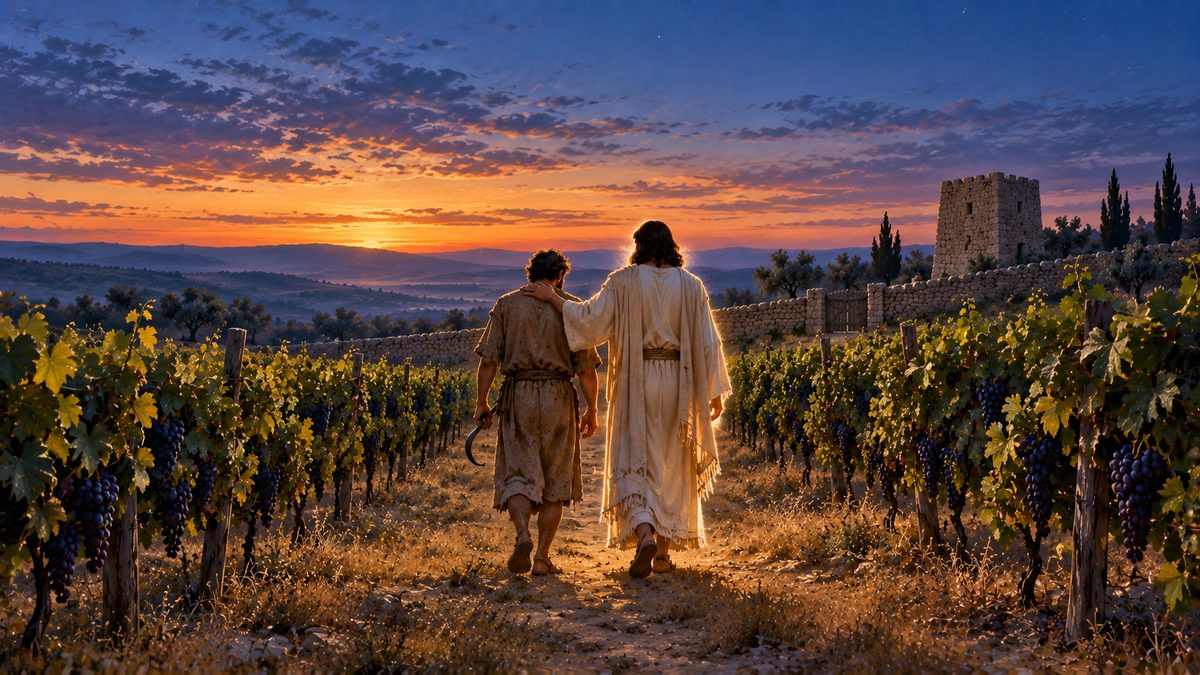
It would be a comfort to read this as a story about them, and it would be a misreading. The tenants are not villains who broke in. They are the people who were actually in the field doing the work, for years, ably, while the owner was far away — and somewhere in those years the vineyard stopped feeling like an arrangement and started feeling like a possession.
That is not a dramatic sin. It is what happens to anything you hold long enough and well enough. A building. A committee. A hymnal shelf. A pew. A name in a town. A church. Nobody decides it; it settles. And the men who heard this parable were not careless people; they were the careful ones, who had given their lives to the place. The parable is not aimed at people who neglected a vineyard. It is aimed at people who loved one until they forgot it was not theirs.
So when Jesus says the kingdom of God will be taken away from you and given to a people that produces the fruits of the kingdom, he is not talking about one people being swapped out for another; that reading has an appalling history, and it is not what the words say. He is talking about tenants, as he has been from the first verse, and every tenant since has held the same lease. If we hear that verse and feel safe, we have just proved we are standing where they were standing.
Here is where it lands in an ordinary week, in a church that has kept a place alive for a long time and loves it. The question the parable leaves in the room is not are we in or out — that was the chief priests’ question, and they lost it. The question is this: when the season comes, does anything of his actually leave this place? Not whether the building is kept up or the service kept in good order; tenants do that for their own sake. Whether the poor of this town are better off because we are here. Whether an honest word gets spoken in our meetings when a flattering one would be easier. Whether a stranger finds a seat held open rather than a seat that is somebody’s. Whether the cry that should never have had to be cried gets heard here first. That is the harvest. Everything else is upkeep.
And on this first Sunday of October, when churches on every continent set one table and call it the Lord’s and not their own, the parable’s hidden mercy is spelled out in bread: other tenants, from every nation, on the same lease, fed from a field none of them planted.
There is one more thing to say, and it is not a threat.
The apostle Paul once had a list. Circumcised on the eighth day, a member of the people of Israel, of the tribe of Benjamin, a Hebrew born of Hebrews; as to the law, a Pharisee … as to righteousness under the law, blameless. A résumé built from exactly what the men in the temple were defending that Tuesday — standing, lineage, office, an unimpeachable record. He wrote it all out, and then he wrote it off. Whatever gains I had, these I have come to regard as loss because of Christ. Rubbish, he calls it, in a word politer translations soften.
And then this:
“Not that I have already obtained this or have already reached the goal; but I press on to make it my own, because Christ Jesus has made me his own.”Philippians 3:12 (NRSV)
It is the same verb both times — to seize, to take hold of, to take possession of — once in Paul’s hands and once done to him. He grasps because he has been grasped first.
Hold that against the sentence in the vineyard. Come, let us kill him and get his inheritance. The tenants reached for a possession. The apostle discovered he was one.
Nothing in this field was ever ours. The planting was not ours, the wall was not ours, the tower and the press were finished before we got here. And the owner has not written it off. He has leased it again — which means that today, this week, in a place we did not build, there is still a harvest expected of us, and there is still time in the season to bring it in.
You are seen. You are loved. And grace has not finished with you yet.
A Closing Prayer
God of the vineyard, everything we have was planted before we came. Forgive us for the slow and comfortable way we begin to call it ours — the room, the work, the name, the church. Teach us what you came looking for: not our singing only, but justice; not our record, but mercy in our hands. And when we reach for what was never ours to hold, remind us that we are already held — that we press on only because we have been taken hold of by Christ Jesus. Make us good tenants of a field we love and do not own.
In the name of the Father, and of the Son, and of the Holy Spirit. Amen.