
“One Denarius”
At the End of the Day
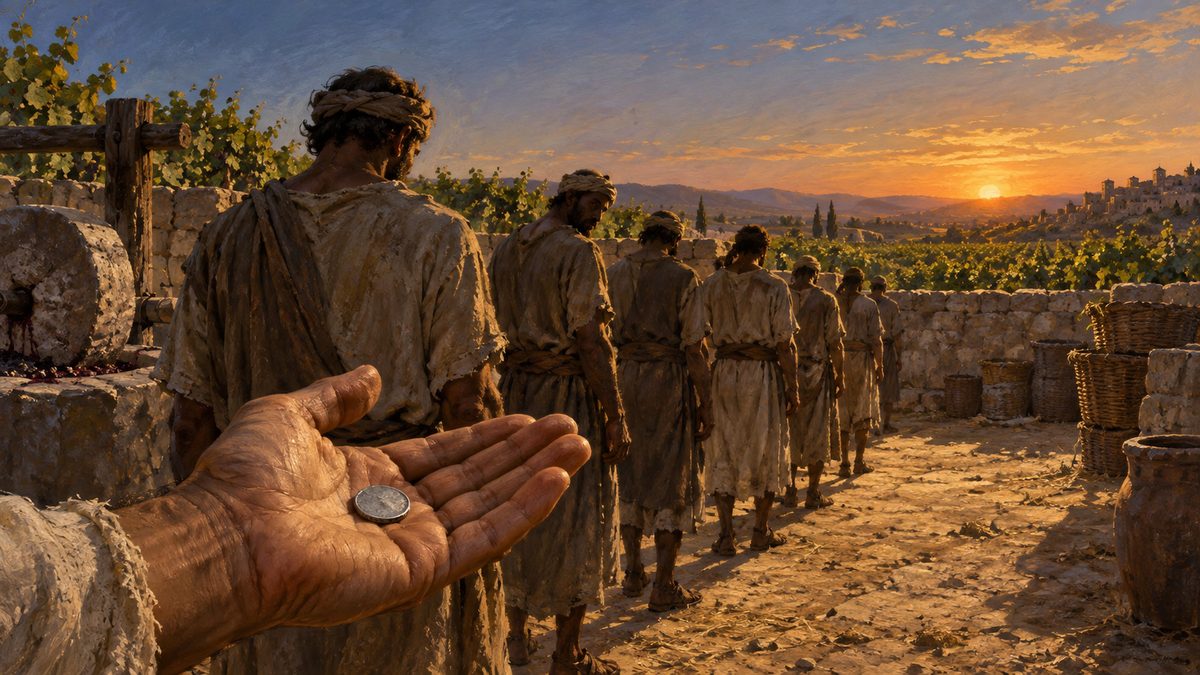
At the end of the day the men stand in a line and do what anyone would do. They watch a man who worked one hour receive a full day’s wage, they run the numbers forward, their hearts lift — and then they are handed exactly what they agreed to at six that morning.
One denarius. A day’s bread for a family. Not a fortune, and not a cheat either: the full contracted wage, paid before sundown as the law required, because the poor cannot wait for their food.
And they are furious.
It would be easy to call that ingratitude. It is not. Matthew tells us what happened in them as they watched: they thought they would receive more. It is the oldest complaint in the human chest, and every one of us has made it: surely there is something more than this.
The Only Ones Who Bargained
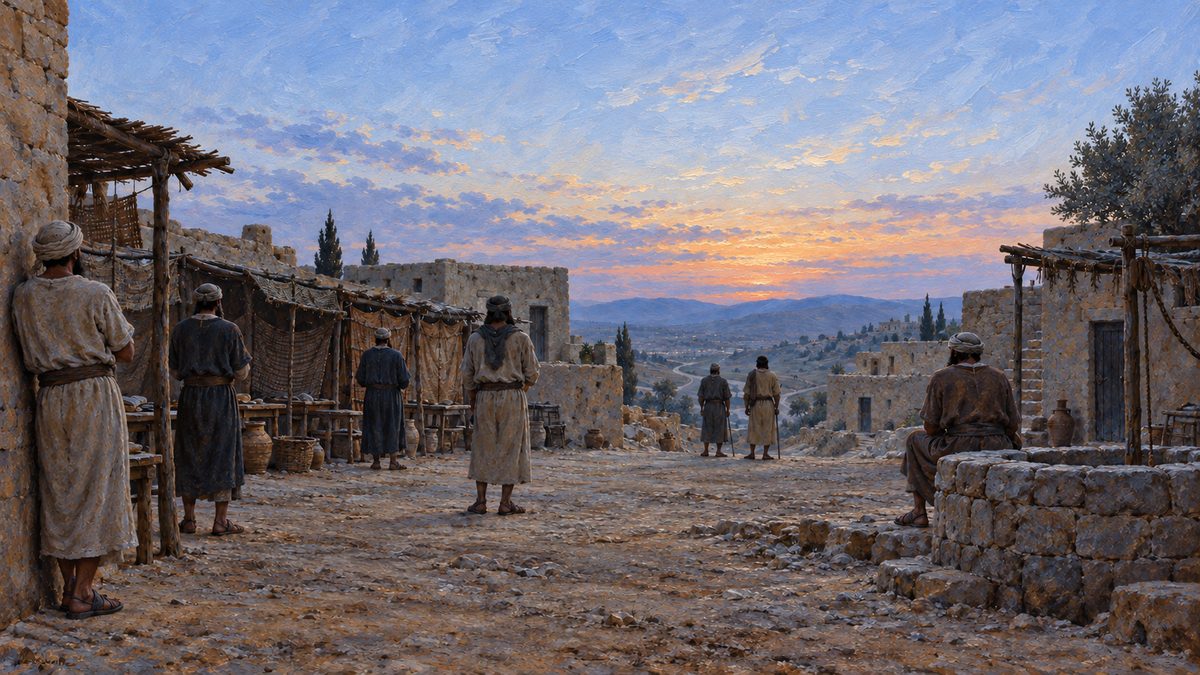
Read the hiring again, because the parable buries its hinge in a detail that is easy to walk past.
With the first crew, at dawn, the landowner agreed with the laborers for the usual daily wage. The Greek is a contract word — they came to terms. A figure was named, and the day was settled.
With every crew after that, he says something entirely different.
“You also go into the vineyard, and I will pay you whatever is right.”Matthew 20:4 (NRSV)
No figure. No terms. No handshake. Just a word given and a word taken.
And they go — the nine o’clock men on that word alone, and the noon men, and the three o’clock men. At five in the afternoon, with one hour of daylight left, he goes back a fifth time. No estate manager makes five trips to the labor market in a single day. He is not staffing a harvest. When he asks the last men why they have stood there idle all day, they give the answer nobody quotes: Because no one has hired us. They were in the square at dawn like everyone else, and were not chosen. He is going back for people.
So by dusk there are two kinds of men in that courtyard: men holding a contract, and men holding a promise — and the promise turns out to be worth what the contract was worth, to the coin.
Which is why, when the grumbling starts, the owner’s answer is not what we expect. He does not say you did not work that hard. He does not say stop complaining. He says, Friend, I am doing you no wrong.
Both halves of that are true — Friend is true, and no wrong is true — and the second is the harder to hear. He does not dispute the work: they did bear the burden of the day and the scorching heat, and the heat in that country is not warmth but the burning east wind off the desert. Twelve hours of stoop labor under it is twelve hours of stoop labor under it, and the parable never pretends otherwise. But nothing was taken from them. Nobody’s wage was cut to pay for anybody else’s. The leveling ran upward, every bit of it.
They were the only men in the vineyard who bargained. And a bargain pays what a bargain says.
Jesus told the story to explain one sentence he had just said, and he says it again when the story ends: the last will be first, and the first will be last. The parable is that sentence with people in it.
There Is Nothing Past It
Notice first that the owner could have paid the dawn crew first. Pay them first and they take their denarius and go home content, and nobody ever learns what the five o’clock men were given — there is no story. Instead he tells the steward to begin with the last, so that the men who worked twelve hours stand in the line and watch. He wants them to see it.
Here is the question the parable is actually asking.
What did they want instead?
Because the denarius is a day’s life. Bread on the table, children fed, the family intact for one more evening. And in the parable it stands for something larger that all of Scripture has been pointing at: a resurrected life, a peace that does not end, a place in the kingdom of God — the thing the prophets kept reaching for words to describe.
So — what is there beyond an eternal life? What would you call the thing past a peace with no end in it? What is greater than the kingdom of God?
We all know the answer. And still, somewhere under the ribs, we think: but it cannot just be that. It cannot be the same for everyone, no matter how much one of us knew, or built, or gave, or endured.
There is nothing more. Not because God is stingy — because there is nothing greater to give. Jesus has just promised Peter a hundredfold and eternal life; then he tells this story, so that Peter will not turn the promise into a ledger. The hundredfold is the denarius. It is not a bigger coin — there is no bigger coin. Nothing can be added to one denarius, because nothing is larger than it. And nothing can be taken away from it either, because it was not calculated at dusk by a man with a ledger. It was promised at dawn, by the One who does not go back on a promise, and handed over at the end of the day exactly as promised.
Which is why the grumbling is so strange and so recognizable. Their denarius was enough at six in the morning. It was enough at noon. It was enough while they were working. It stopped being enough the moment they stood in a line and looked sideways.
That is what the owner’s last question names, and it is the sharpest thing in the parable.
“Or are you envious because I am generous?”Matthew 20:15 (NRSV)
The Greek underneath is older and stranger — is your eye evil because I am good? The evil eye has nothing to do with curses; it is the grudging look, the eye that narrows at somebody else’s good fortune. Matthew has used the phrase once before, in the Sermon on the Mount, in the middle of the passage about treasure and serving two masters — it is a word about money, and about what looking at other people’s does to you. And notice what he does not say. Not is your eye evil because I am unfair. Because I am good. The goodness is what produced the resentment.
And notice who he is talking to. Not the newcomers — the ones who have been there since six in the morning. In Matthew that means Peter, who had just asked out loud what he would get for leaving everything behind. In any church it means the people who have carried the place for thirty years and have every right to be tired. This parable is not a rebuke of the faithful. It is a word spoken to the faithful, with real affection, about the one thing that can sour a lifetime of faithfulness in a single afternoon.
Take What Is Yours and Go
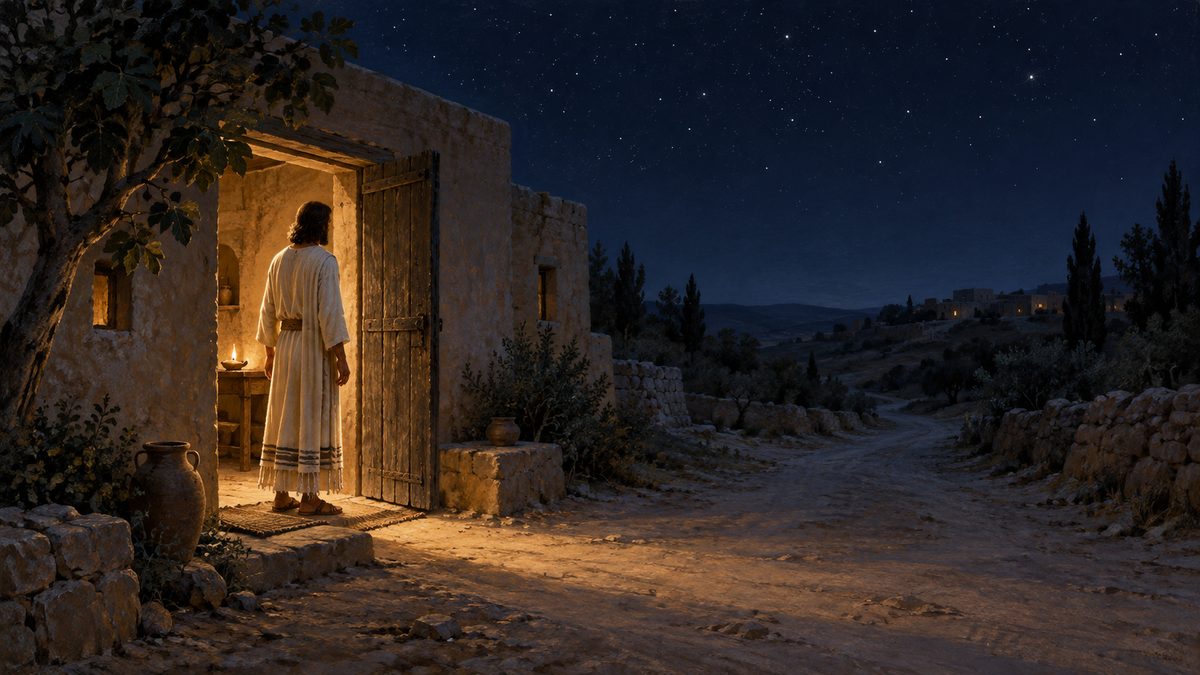
And then the owner says something that sounds like a dismissal and is not.
“Take what belongs to you and go.”Matthew 20:14 (NRSV)
Go home. The day is over, the wage is in your hand, the vineyard closes behind you. That is not a punishment. That is what the end of a day’s work is for.
We spend a great deal of life running toward a finish line, and the strange thing about this one is that it is where we started. Every one of us came into the world the same way: with nothing in our hands, an unguarded smile, no agenda at all, and none of what has since taken that smile off our faces. Kings and conquerors and scholars have all worked longer and reached further to become something more than mortal, and every one of them proved, in the end, only that he was mortal, and went home the way he came. Job said it first, and said it as a prayer: naked I came from my mother’s womb, and naked shall I return there.
So the day is not for accumulating. Picking up brighter pebbles along the path does not change where the path ends. The day is for walking in the garden with the One who made us — in the evening breeze, the way it was before we learned to hide — and with the brothers and sisters he keeps putting beside us, for as long as we are given. That is the whole of it, and always was.
But do not hear that as though the day did not matter. It matters enormously. It just cannot be traded for anything. The hands are empty at the end because nothing in them was ever the wage — not because the walking meant nothing. The Lord who was raised still carried the marks of the nails in his hands. Nothing is wasted. It is only that none of it was ever currency.
One denarius. Promised at the beginning, given at the end. Nothing greater can be added to it, and nothing can be taken from it, because nothing is greater than our God, and nothing in all creation can separate us from his love.
So if you are tired, and you have been at this a long time, and some part of you has started keeping score — put the score down. It was never going to tell you anything true. You have not been shortchanged, the people who came late have not been given your share, and there was never a larger portion held back from you for a better year.
There is a landowner who went out to the marketplace five times in one day because he could not bear to leave anyone standing there. And at the end of the day there is bread, and a road, and a house with the light on.
You are seen. You are loved. And the light is on.
A Closing Prayer
Gracious God, you have promised us more than we could ever earn — not more than we keep demanding, but simply everything: your life, your peace, your kingdom, your own self. Forgive us the ledger. Forgive us the sideways look, and the way your goodness to someone else can sour in us before we have even noticed. Keep us from measuring a day you meant us to walk through. And when the light goes and the work is done, bring every one of us home with empty hands and no fear, to the place we set out from.
In the name of the Father, and of the Son, and of the Holy Spirit. Amen.