
“Whose Image?”
A Trap in the Temple
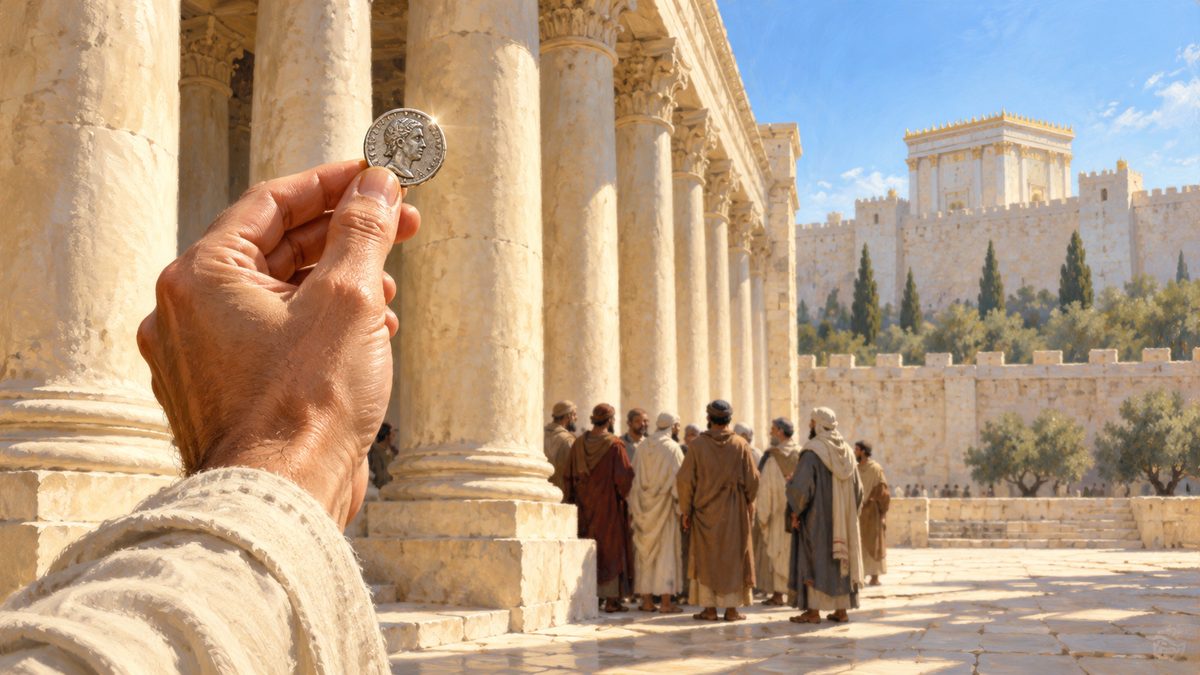
The stories are over. Now they set a trap.
Matthew says the Pharisees went and plotted to entrap him in what he said. The verb is the fowler’s snare hidden in the grass, and Matthew names the bait: what he said. They mean to catch him with a sentence.
They send two groups who agree on almost nothing: the Pharisees’ disciples, who resented the Roman tax, and the Herodians, whose power rested on Rome’s goodwill. Two parties who could not share a table have found they can share a target.
Then they open with praise:
“Teacher, we know that you are sincere, and teach the way of God in accordance with truth, and show deference to no one; for you do not regard people with partiality.”Matthew 22:16 (NRSV)
Every word of it is true. It may be the truest thing anyone says about Jesus all day, and they mean none of it. A man who shows no partiality will have to say something that costs him one side of the room.
Then the question:
“Tell us, then, what you think. Is it lawful to pay taxes to the emperor, or not?”Matthew 22:17 (NRSV)
Or not. Say yes, and the Pharisees’ people tell the crowd he sides with the occupier. Say no, and the Herodians tell the governor he is preaching revolt. This tax has already cost lives in Judea. It is the most dangerous question in the land, and they ask it in the temple.
The Coin in Their Pocket
Jesus names it: Why are you putting me to the test, you hypocrites? Then he does not answer. He asks for something.
Show me the coin used for the tax.
He does not have one. They do.
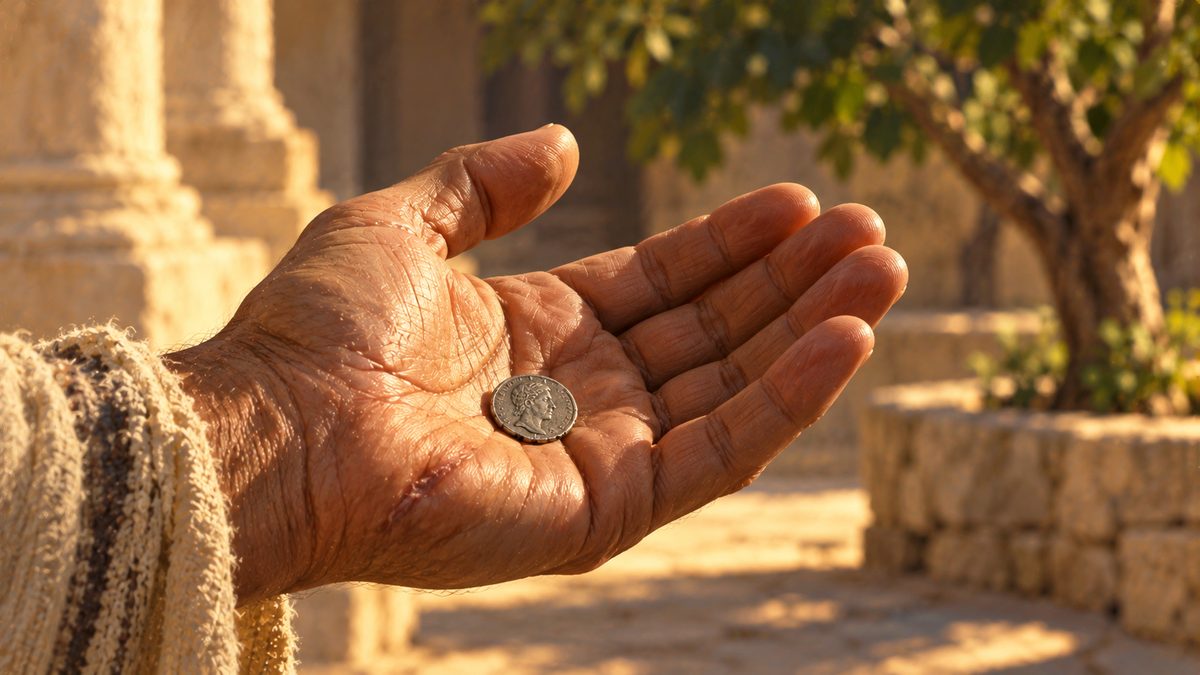
The scene turns on a gesture before it turns on a word. The men asking whether it is lawful to hand this coin to Caesar reach into their own purses, in the courts of God’s house, and bring one out. And they brought him a denarius. Matthew’s verb for brought is the one he uses for bringing a gift to the altar. An offering carried forward in the temple, with the wrong face on it.
The coin most likely bore the head of Tiberius, named in Latin as son of the divine Augustus, and on the reverse, high priest: a small silver disc making two religious claims at once.
So before Jesus has said a word, the question has been answered. Whatever these men say about Caesar’s money, they are carrying it.
For years I read this scene as a trap sprung on other men. This week I noticed the purse. I know that purse.
Then the question that springs it:
Whose head is this, and whose title?
They have to answer, and it costs them one word: The emperor’s.
Give Back
“Give therefore to the emperor the things that are the emperor’s, and to God the things that are God’s.”Matthew 22:21 (NRSV)
Two small words in the Greek carry the whole sentence.
The first is the verb. They had asked whether it was lawful to give the tax. Jesus answers with a different word: give back. It is Matthew’s verb for repaying a debt. The coin is not a gift to Caesar. By their own answer it is already his. So hand it back. Caesar’s claim is real, and it is about the size of a coin.
The second is the word our Bibles translate head. On a coin, head is the right English. But the Greek word is eikōn, image, and every Jew in that courtyard who knew the Scriptures in Greek had met it on the very first page:
“So God created humankind in his image, in the image of God he created them.”Genesis 1:27 (NRSV)
Whose image is this? On the coin, Caesar’s. So the coin goes back to Caesar.
And whose image is on you?
Jesus never asks that second question aloud. The logic sits in the word therefore: it bears his image, so it is his, so return it. Run it through the second half of the sentence. What bears God’s image belongs to God.
He asked about the inscription too. One chapter before this Sunday’s reading, Isaiah sees a day when someone will write on the hand, “The LORD’s.” An image, and a name. The church has an old word for the morning God’s name was written on you, with water, in front of witnesses. We call it baptism.
Tertullian, a century and more after Matthew, put it in one line: give Caesar his image, which is on the coin, and give God his image, which is in the human being.
The sentence sounds balanced. It is not. The coin is a small thing you can hold between two fingers. The image of God is the person holding it.
Not Two Kingdoms
It is easy to hear this as a fair division: God gets the soul, the government gets the rest. The other readings this Sunday will not allow it.
The psalm sings, For all the gods of the peoples are idols, but the LORD made the heavens. The Hebrew makes a pun of it: elohim, gods; elilim, nothings. The words almost rhyme. The things do not. That is the psalm’s comment on a coin that calls a man the son of a god.
Isaiah hears God speak to Cyrus, a Persian emperor who worshipped other gods, and call him my anointed, the very word that will become Messiah. Then God says to him, twice, though you do not know me. Cyrus will do God’s work and never know it. I am the LORD, and there is no other.
There is no ruler God cannot use, and no ruler, however useful, is God’s partner, or God’s rival, or the Messiah. Isaiah’s Cyrus has been pressed into service in our own day to bless one leader or another. The text will not carry that weight.
Caesar’s small claim sits inside God’s large one, the way a coin sits in a hand. That also settles the day a ruler reaches for the second half of the sentence. The church has known that answer for two thousand years, and has paid for it. Caesar may have the coin. Caesar may not have you.
In a season like this one, when every sentence gets picked up and swung, notice who walked away: When they heard this, they were amazed; and they left him and went away. The Pharisees and the Herodians, the resisters and the accommodators, both of them. He gave neither side the answer it came for. He gave both the same one: the coin is small, and you are not the coin.
The Thessalonians turned to God from idols, to serve a living and true God, in a city whose own coins honored the emperor. What they turned from was not citizenship. It was worship.
The Image You Carry
And here the clever answer turns into good news.
If what bears Caesar’s image belongs to Caesar, then what bears God’s image belongs to God. That is every person in this room, and every person in Roswell. It is the neighbor you find hardest to love this autumn. The image does not come off. A coin can be defaced. What God has stamped cannot.
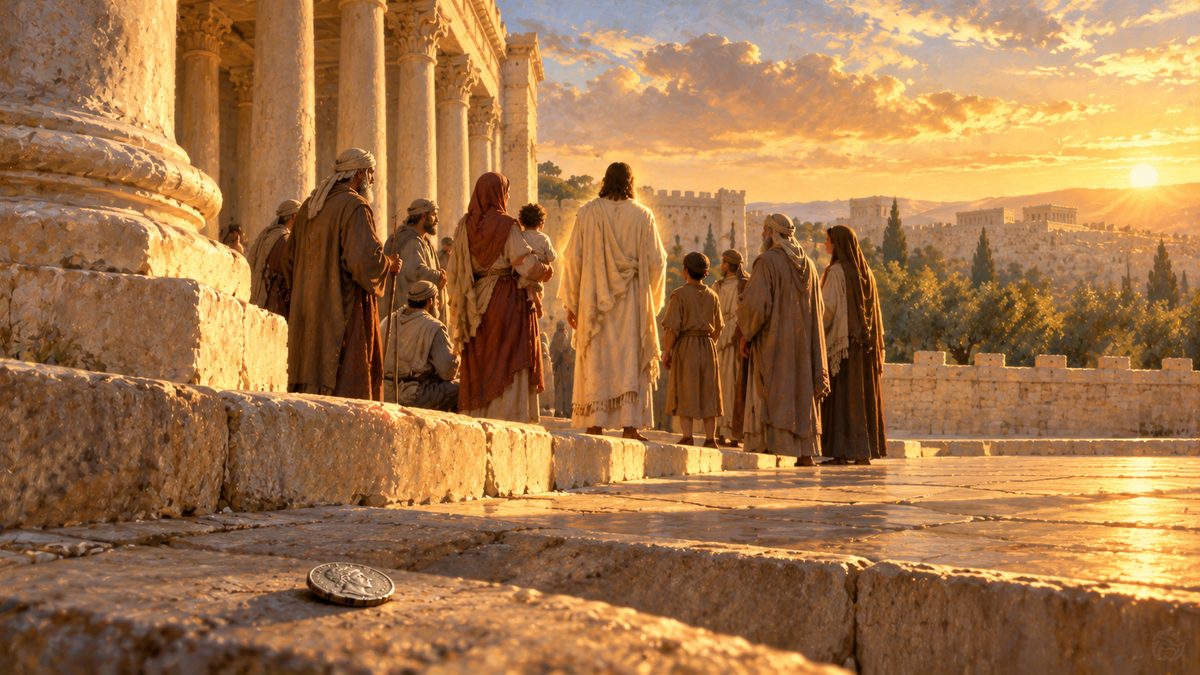
And then the image did something no coin can do. It came and stood in that temple courtyard and asked to be shown a denarius. He is the image of the invisible God, Paul would write of Jesus. The face on the coin belonged to a man his coins called the son of a god. The face looking at it belonged to the Son of God, who had no coin to show, and who within days would have an inscription of his own fixed above his head on a cross.
So the second half of Jesus’ sentence is not a burden laid on top of the first. You are not a coin God is collecting. You are an image God made, and God has never once looked at you without seeing his own face there.
You were God’s first. You are God’s still. The image is his, and it is on you.
You are seen. You are loved. And grace has not finished with you yet.
A Closing Prayer
Living and true God, you made us in your image before any ruler struck a coin, you wrote your name on us in the water of baptism, and you have never let that likeness be rubbed away. Give us honest hands in the life of our city: to pay what we owe, to pray for those who govern, and to vote and speak and listen as people who belong to you. Guard us from the fear and anger of this season. Open our eyes to your face in those with whom we disagree. And keep us glad to give ourselves back to the One whose image we bear, Jesus Christ our Lord, the image of the invisible God.
In the name of the Father, and of the Son, and of the Holy Spirit. Amen.