
“Where Everything Hangs”
The Lawyer’s Question

The last question they put to him comes from a lawyer.
It has been a long day of questions in the temple courts. Now the Pharisees gather again, and one of them, an expert in the Law, steps forward. Matthew says why: to test him. It is a trap with a seminar question for bait.
“Teacher, which commandment in the law is the greatest?”Matthew 22:36 (NRSV)
Name one as greatest, and you seem to shrink the rest. Refuse, and you are a teacher with no center.
Jesus names one. Then he names a second that nobody asked for.
“You shall love the Lord your God with all your heart, and with all your soul, and with all your mind. This is the greatest and first commandment. And a second is like it: You shall love your neighbor as yourself. On these two commandments hang all the law and the prophets.”Matthew 22:37–40 (NRSV)
Nothing in that answer is new, and that matters. The first line is the Shema from Deuteronomy; the second is from Leviticus. The great rabbis gave answers of this kind too. Hillel, asked for the whole Torah, said: What is hateful to you, do not do to your neighbor. Jesus does not replace Israel’s Scripture; he opens it at its heart, as Israel’s Messiah.
But he does three things with it that the lawyer did not expect.
Like It
First, he will not let the two commandments come apart.
The lawyer asked for one. Jesus gives two, and between them sets two words Matthew alone records: like it. The second commandment is the same love facing a different way. Love of God goes up, toward the One you cannot see. Love of neighbor goes across, toward the one you can.
Love of neighbor cut loose from love of God turns, sooner or later, into a cause, or a mood, or plain exhaustion. John put the two in one sentence: those who do not love a brother or sister whom they have seen, cannot love God whom they have not seen.
Second, notice what he loves God with. Deuteronomy says heart, soul, and strength. Matthew’s Jesus says heart, soul, and mind. Worth asking, in an autumn like this one, what our minds have mostly been given to, and whom we have argued with at two in the morning. The first psalm calls the place where a mind settles into contempt the seat of scoffers, and its happy person will not sit there. With all your mind.
Third, and most important, he quotes a verse whose neighborhood matters.
Signed
Love your neighbor as yourself is not a free-floating proverb. It is the last line of a paragraph in Leviticus 19. The chapter opens, You shall be holy, for I the LORD your God am holy, and spends that holiness on ordinary things. This paragraph is about courts and speech.
You shall not be partial to the poor or defer to the great. You shall not go around as a slanderer among your people. The Hebrew word is a peddler. You shall not hate in your heart anyone of your kin; you shall reprove your neighbor. The Torah’s alternative to secret hatred is not silence but honesty: the hard thing said to the person, not about the person. You shall not take vengeance or bear a grudge … but you shall love your neighbor as yourself.
Read that way, love is first a list of what it refuses: peddled talk, hatred nursed in private, a score kept.
In a season of division, that list needs no commentary. It does not tell anyone which side to take. It tells everyone how to treat the people who see things differently: the relative at Thanksgiving, the co-worker, the neighbor two doors down. Jesus supplies the margin note in the Sermon on the Mount: love your enemies. The neighbor includes the one on the other side.
That is harder than it sounds. Kindness comes easily to our own and hard to the stranger, because difference is the first thing we notice, and we read different as wrong.
Leviticus will not allow it. Later in the same chapter it says: you shall love the alien as yourself, for you were aliens in the land of Egypt. Neither will Jesus. Before that week is out he says, I was a stranger and you welcomed me. Remember who we were when Christ died for us. While we were enemies, Paul says, we were reconciled to God. Israel was told to love the stranger because it had been the stranger. We are told to love the enemy because we were the enemy, and were loved first.
Every few lines, Leviticus signs the paragraph: I am the LORD. The signature is the reason. We love because of who God is, and Psalm 103 says who that is: He will not always accuse, nor will he keep his anger forever. He does not deal with us according to our sins. The God who forbids the grudge is the God who holds none against you.
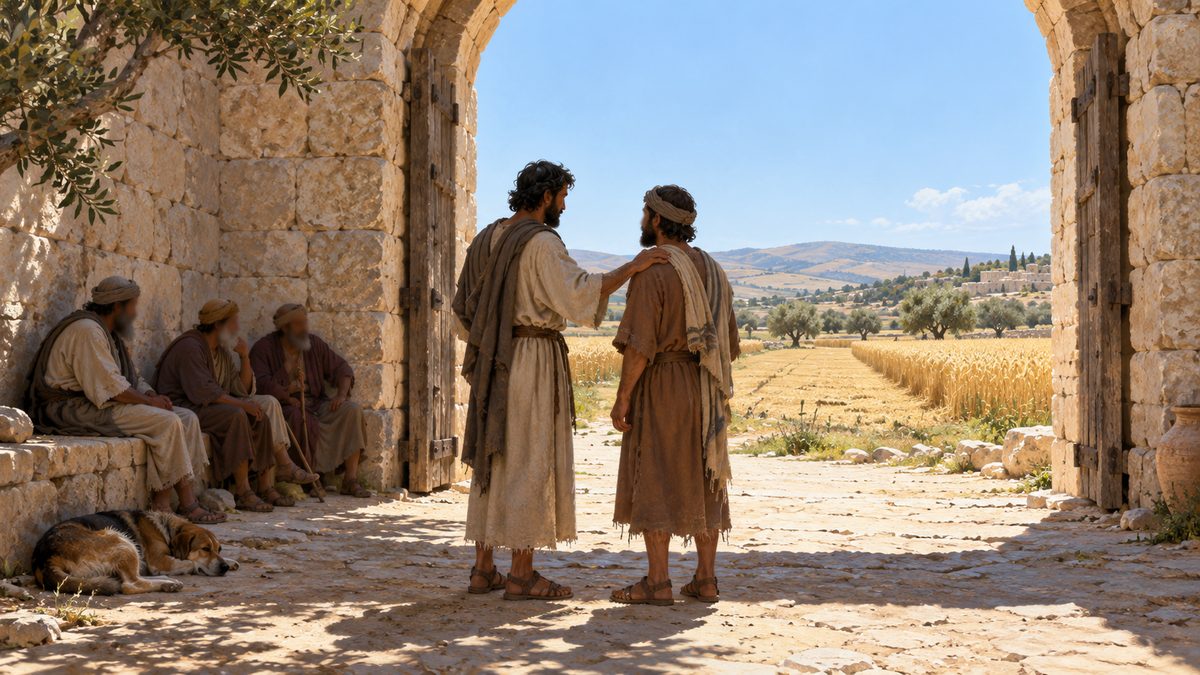
Paul knew what this looks like. He tells the Thessalonians he never came with words of flattery. Instead, we were gentle among you, like a nurse tenderly caring for her own children. Then the sentence holding both commandments at once: we are determined to share with you not only the gospel of God but also our own selves, because you have become very dear to us. His word for selves is the word for the soul we are to love God with. Love God with your whole soul. Then hand that soul to the people in front of you.
Whose Son?
Then Jesus asks the last question of the day himself.
All day he has been questioned. Now the direction reverses. What do you think of the Messiah? Whose son is he? It is the same small word Jesus asked over the coin last Sunday: whose.
The son of David, they answer. But Jesus quotes a psalm in which David calls the Messiah my Lord. If David thus calls him Lord, how can he be his son?
No one can answer him a word. From that day, Matthew says, no one dared to ask him anything more.
It is not a change of subject. The lawyer asked what the Law requires, and Jesus told him: everything for God, and the neighbor as yourself. Then Jesus asked who the Messiah is, and the whole Gospel’s answer is that he is more than David’s son. He is the Son who is also Lord. The Law asks for a love no one in that courtyard, and no one since, has ever fully given. And standing in the courtyard is the one person who will give it: everything to the Father, and his life for his neighbors, including the men testing him that afternoon.
Do not hear that silence as a victory. The story goes on to a cross. The gospel is not that he silenced them. It is that he kept, in their place and ours, the commandments they were quoting.
Where It Hangs
On these two commandments hang all the law and the prophets. It is the word for a household hung from one strong peg in the wall. All of Scripture hangs from these two pegs.
Within days the one who said it would hang on a tree. Matthew does not use that word for the cross; the church soon would. He hung there for both commandments at once: for love of the Father, and for love of us.
The commandment is written in the future tense: you shall love. In the grammar it is a command. John Wesley said it about this very commandment: every command in Holy Writ is only a covered promise. Underneath you shall love is a promise: you will love. One day this sentence will simply describe you.
So the greatest commandment is not first a thing you must do. Before it was ever a demand, it was a deed. Everything hangs on love, and Love hung there, for you.
You are seen. You are loved. And grace has not finished with you yet.
A Closing Prayer
Gracious God, you are the LORD, and you keep no grudge against us. Teach us to love you with all our heart and soul and mind, and to love our neighbors as ourselves, in what we say about them and in the honest words we owe them. In this season of division, guard our tongues from slander and our hearts from hatred, and open our doors to the stranger. Make us gentle with one another, as a nurse with her own children, and willing to share not only the gospel but our own selves. And when we fail the commandment on which everything hangs, bring us back to the one who kept it for us, Jesus Christ, David’s son and David’s Lord, who loved you and us to the end.
In the name of the Father, and of the Son, and of the Holy Spirit. Amen.