
“A Breath in the Locked Room”
The Pentecost the Imagination Expects
When most people hear the word Pentecost, the scene that rises is the one from Acts 2 — wind, tongues of fire, a Spirit-given fluency in foreign languages, a crowd from every nation pressed against the door, Peter preaching his first sermon, three thousand baptized before sundown. That is the Pentecost the Christian imagination most often expects. The expectation runs deeper than this one feast: ask Christians what they picture when they imagine Christ’s return, and most paint something similar — clouds split, trumpet sounding, every knee bowing. The great moments of God, the imagination assumes, must be loud.
But the Lord at the center of this faith has shown a stubbornly different pattern. He entered Jerusalem on a borrowed donkey on the day that could have been the most public of his life. In Gethsemane he refused to call down the twelve legions of angels that were his to summon, and let himself be led away like a lamb. He was born in a stable, laid in a feed trough, and spent thirty quiet years sanding cedar in his father Joseph’s shop — the hands that would bless bread and children, the hands the nails would go through, already calloused from a carpenter’s bench.
Christianity has had a recurring temptation to turn itself into a show. The Lord at the center of it has been, from the first moment, on the opposite side of all of that — with the poor, with the abandoned, with the sinners. To know where Jesus is, the place to look has never been the spotlight; it has been the people no one notices. And to know how Jesus gives his Spirit, the place to listen is John 20.
The Quietest Easter
The greatest event in the history of the human race happened on a Sunday morning, and the world barely noticed. Mark records two women coming to the tomb before sunrise, carrying spices, worrying out loud about who would roll back the stone. There was no trumpet, no rending of the heavens, no angelic chorus over Jerusalem — only an open tomb, a folded burial cloth, and a young man in a white robe saying, He is not here. The greatest news ever delivered to any human being was delivered as an empty cave and a sentence.
The risen Jesus, when he began to appear, chose forms that match. To Mary, he came as a gardener. To the two on the road to Emmaus, as a fellow traveler. To the disciples on the lakeshore, as a man tending a charcoal fire. The firstborn of the new creation — conqueror of death itself — came to his disciples as a gardener, a traveler, and a man by the fire.
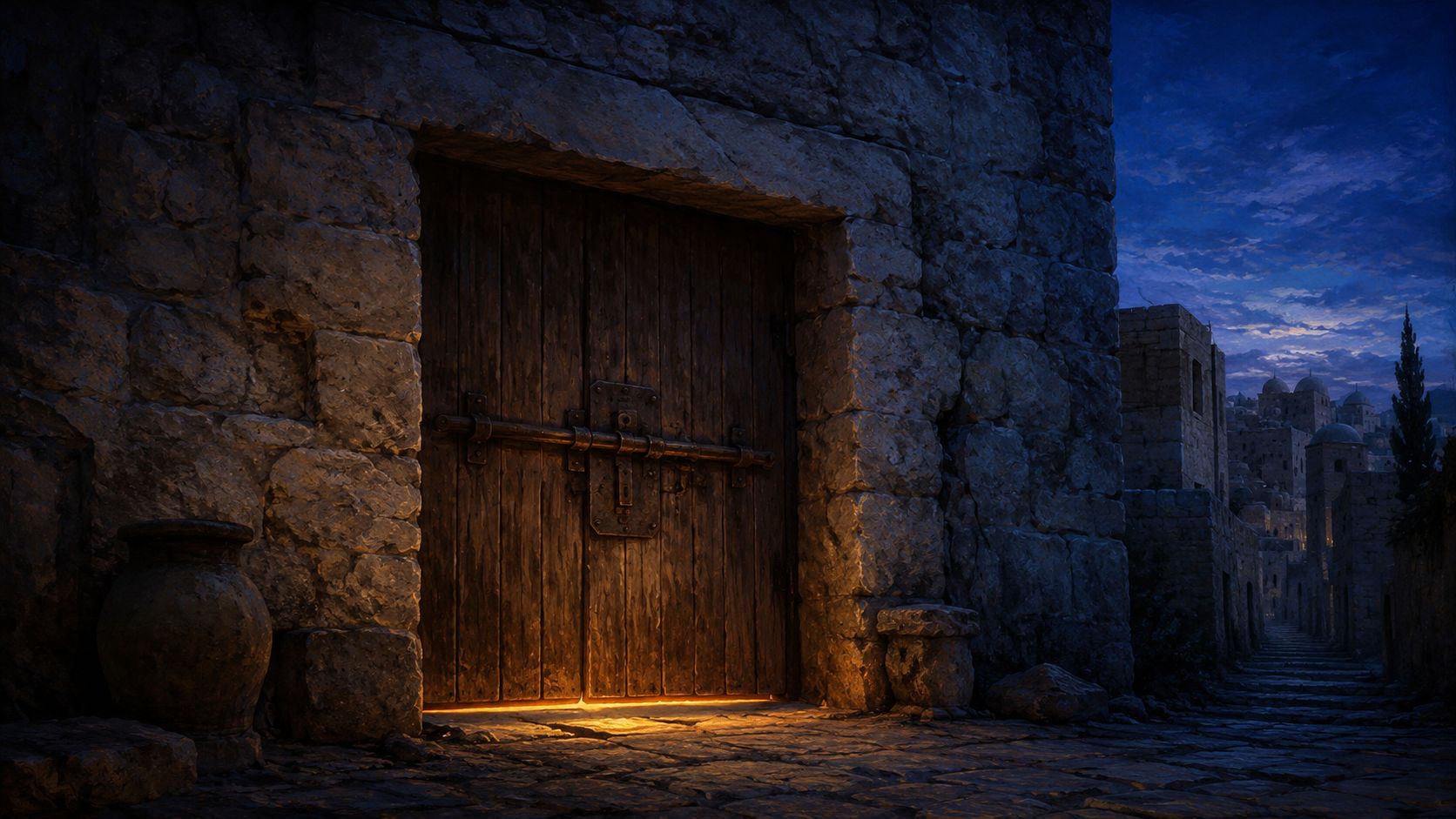
This is who he is. And so when, in John 20, the risen Christ gives his Spirit, there is no wind, no fire, no public square, no crowd. There is a locked room, a few terrified disciples, and a Lord who breathes. That is the Pentecost the Fourth Gospel shows.
A Breath in the Locked Room
“When it was evening on that day, the first day of the week, and the doors of the house where the disciples had met were locked for fear of the Jews, Jesus came and stood among them and said, ‘Peace be with you.’ After he said this, he showed them his hands and his side… He breathed on them and said to them, ‘Receive the Holy Spirit. If you forgive the sins of any, they are forgiven them; if you retain the sins of any, they are retained.’” John 20:19–23 (NRSV)
Look at who is in that room. Peter is there, three days after swearing three times that he did not know the Lord. The disciple whom Jesus loved is there. So are the rest who scattered in Gethsemane, who watched the cross from a distance if at all, and then bolted the door because they were certain that whoever had killed their rabbi was coming for them next. Thomas is not there yet; he will not believe a word of it when he hears.
This is not the apostolic dream team. This is a company of failures, hearts frozen by grief and shame — people who have not yet been forgiven, have not yet forgiven themselves, and cannot yet imagine that Easter is for them.
And to them, the risen Christ comes. John uses a Greek perfect passive participle for the locked doors — kekleismenōn — that carries the sense of barricaded and staying barricaded. The risen Christ does not require an unlocked door. He comes through the locks of their fear and stands, the Greek says, en mesō — in the middle, at the very center of the room.
He shows them his hands and his side. The wounds are still on the resurrection body. The cross has not been airbrushed away. The Lord who comes through the door carries the marks of the world’s worst into the new creation; they recognize him because the wounds are still there. He says, Peace be with you — the very peace he had promised at the table two nights before. Easter peace is not the absence of trouble; it is the presence of the risen Lord in the middle of it.

And then John records the smallest, quietest, most cosmic thing in the Gospels. He breathed on them. The Greek verb is enephysēsen, and it appears nowhere else in the entire New Testament. John reserves it for this single moment. The reason is that in the Greek Old Testament — the Bible the early church read — this is the verb of Genesis 2:7: the LORD God breathed into the human’s nostrils the breath of life. It is also the verb of Ezekiel 37, when the LORD commands the prophet to prophesy to the breath, that it might breathe upon the slain in the valley of dry bones, that they may live.
It is the verb of the creation of the human being and the verb of the raising of the slain. John deploys it here, in a locked room, on broken people who have failed, to say what the risen Christ is doing: he is making a new humanity. The eighth day of creation has begun — not in a stadium, not in a public square, but in a small room, with frightened people, by a breath.
And that breath is warm. It carries the warmth of the Lord’s own body, of the Lord’s own love, into frozen chests. As the warmth enters, grief loosens. Clenched places begin to feel again. The locked room is not yet unlocked, but the people inside it are no longer locked.
A Heart Strangely Warmed
If that sounds familiar, it should. On the evening of May 24, 1738 — two hundred and eighty-eight years ago, to the day this sermon is preached — John Wesley went to a small society meeting on Aldersgate Street in London. He had just come home from a mission to Georgia that had, by his own account, collapsed; he had gone to preach the gospel and had come back convinced he had nothing of the gospel left to preach with. On the boat home he had written, I went to America to convert the Indians; but oh, who shall convert me? That night, as someone read aloud from Martin Luther’s preface to the Epistle to the Romans, something happened to him that he could only describe with one of the most famous sentences in Methodist memory:
“About a quarter before nine, while he was describing the change which God works in the heart through faith in Christ, I felt my heart strangely warmed. I felt I did trust in Christ, Christ alone, for salvation: and an assurance was given me that he had taken away my sins, even mine, and saved me from the law of sin and death.” John Wesley, Journal, 24 May 1738
A warmth. Not a fire. Not a vision. A warmth in the heart, and inside that warmth, the same gifts the disciples had received in the locked room — assurance, forgiveness, restoration, reconciliation, courage. After Aldersgate, Wesley went back across the Atlantic to the colonies that had broken him, and he was not the same man. The Methodist movement that grew out of him — planting churches in English mining villages, on American prairies, and eventually in a small town in New Mexico called Roswell — grew out of one warmed heart. Same breath. Same warmth. Same risen Christ. Same Spirit. And every renewal of the church since has happened the same way: not by spectacle, but by the warm breath of the risen Christ entering frozen rooms full of frightened people and, slowly, quietly, mending them into a new creation.
Forgiven, Sent, Living
The word gospel simply means good news, and Pentecost answers the question of what the news is news about. It is good news about healing, about forgiveness, about restoration, about reconciliation — the assurance that a relationship with the Father, frozen by sin and thawed by the cross, is alive again, reconnected, given. It is good news that the locked door is no longer the safest thing in the world.
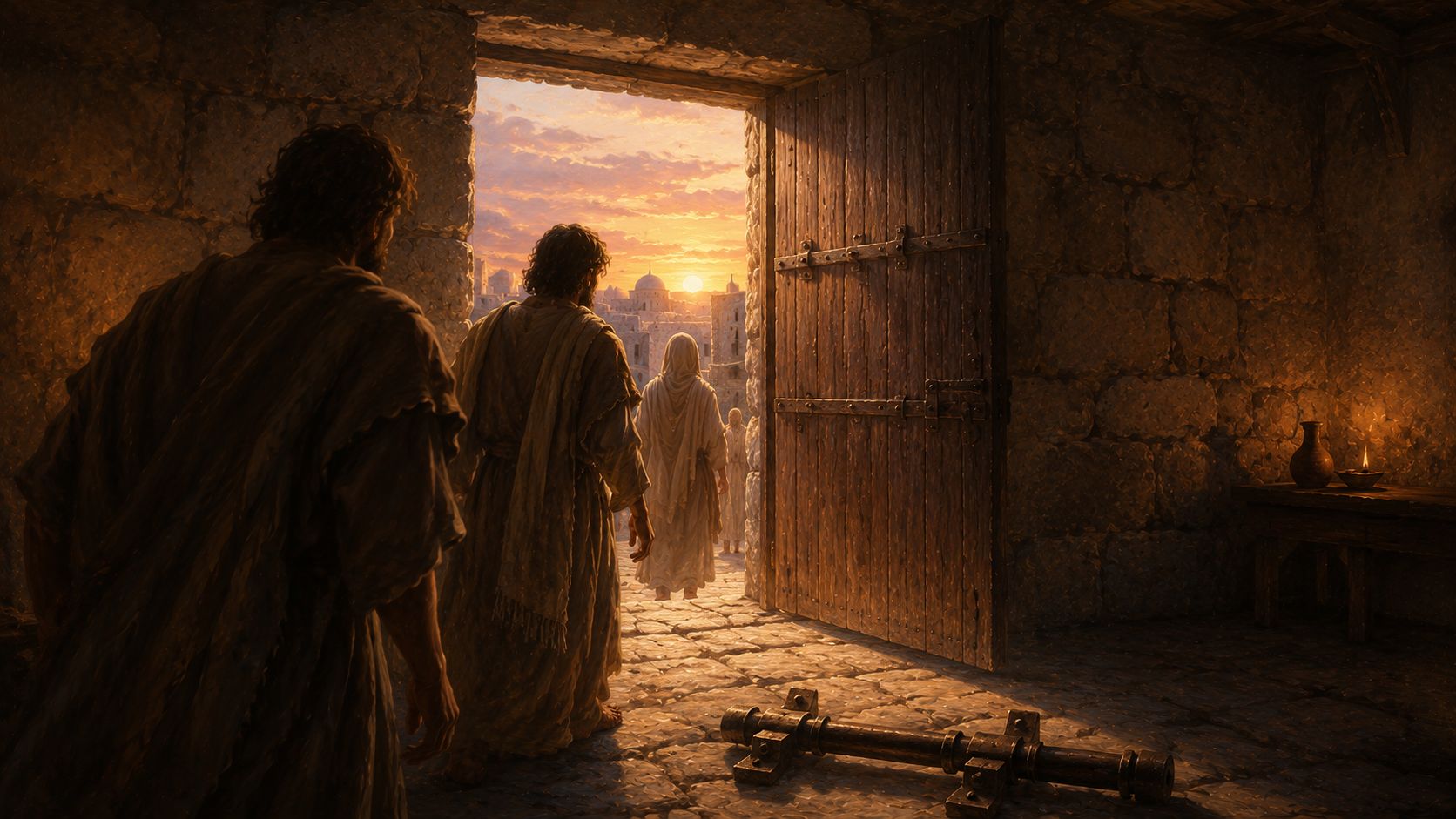
When Jesus tells the disciples, as the Father has sent me, so I send you, he is not asking them to put on a show. He never did one himself. The disciples who walked out of that locked room did not, mostly, become great public preachers. Most of them simply lived a different kind of life — quietly, ordinarily, faithfully — and the world watched, and a few people at a time said, I want what they have.
That is still the shape of the vocation. The call of those in whom the warm breath of the risen Lord is at work is not to proclaim anything spectacular; it is to live the life that breath has begun — forgiven, restored, reconciled, unafraid — as evidence walking around the seven-day world that the new creation has already begun on the eighth day, in a small room, by a breath.
A Closing Prayer
Risen Lord Jesus, you came through the door of every locked room, showed us your wounds, spoke peace into our fear, and breathed your warm Spirit into broken hearts to make them new. Thank you for a Pentecost that does not need a stage.
Thank you for warmth that mends what spectacle could never reach. Thaw the frozen places in us. Send us, as you sent the disciples and as you sent your servant Wesley, into the world — not to perform, but to live what you have made of us.
In the name of the Father, and of the Son, and of the Holy Spirit. Amen.