
“From Emmanuel to Always”
The First Word and the Last
Every great story has a first word and a last word, and in the finest of them the last word answers the first. Matthew, the most deliberate architect among the evangelists, built his Gospel between two such brackets. The first word arrives in a dream: an angel speaks a name into the silence above the sleeping Joseph — Emmanuel, which means God with us (Matthew 1:23). The child will gather many titles before the story is done, but the angel’s first word for him is not a virtue or an office. It is a location. He is the God who is with us.
The last word comes on a mountain, twenty-eight chapters later. The risen Christ tells the eleven, “And remember, I am with you always, to the end of the age” (Matthew 28:20). It is the final sentence of the Gospel, and the Gospel does not so much end as trail off into open air — for the risen Lord is still standing there, still speaking, in every generation that learns to hear him.
Between those two brackets — between Emmanuel and always — everything happens: the Sermon on the Mount, the parables, the cross, the empty tomb. Each of the twenty-eight chapters is, in its own way, a working-out of what kind of with-us God this is. And on Trinity Sunday the brackets close — not on a sentiment and not on a farewell, but on a Name. A triune Name. The God who has been present from the manger to the mountain is the Father who creates, the Son who is with us always, and the Spirit who keeps the communion alive. The church is the company baptized into that Name.
The Mountain
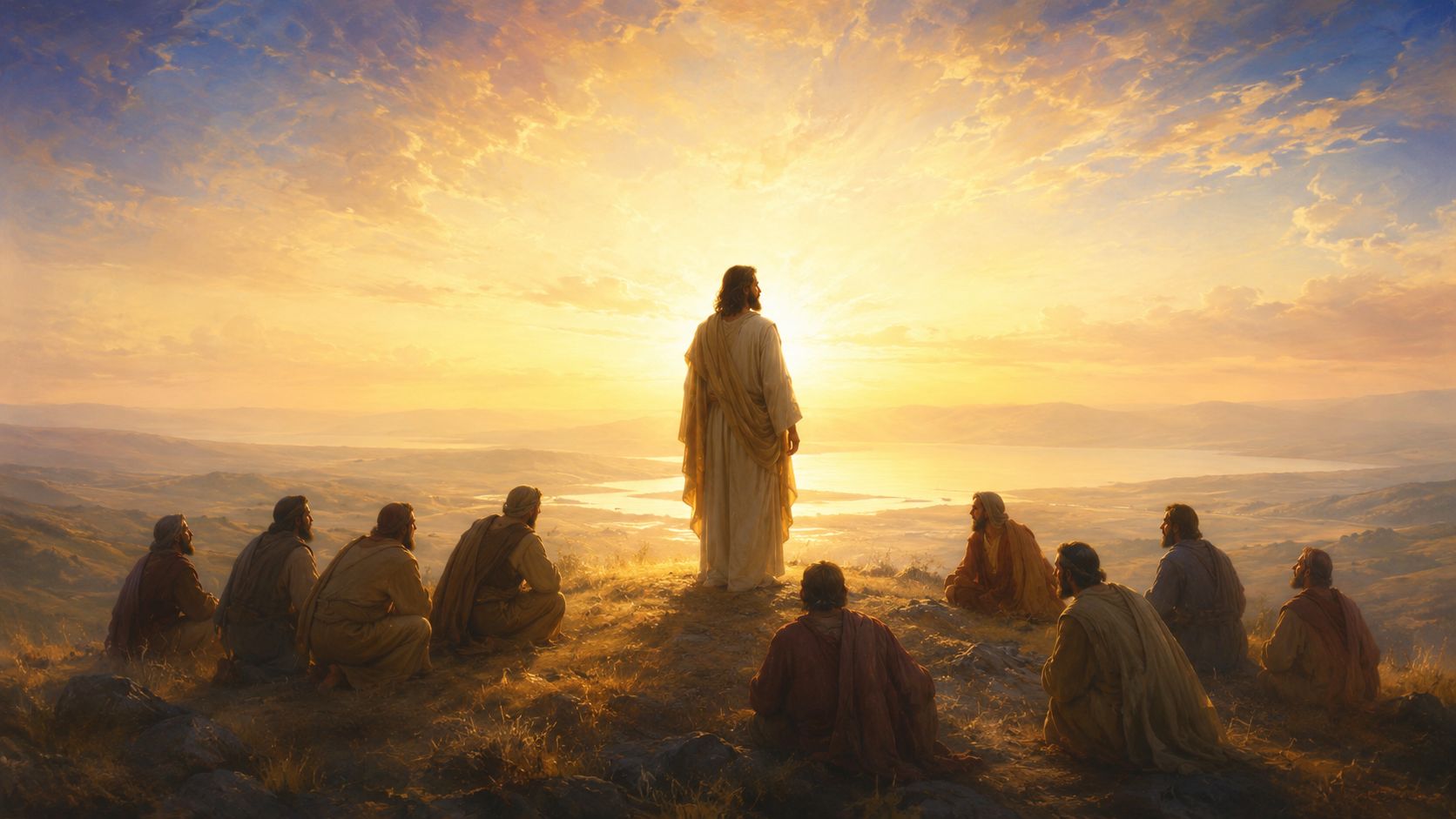
The eleven disciples went to Galilee, to the mountain to which Jesus had directed them. Matthew loves mountains. The Sermon on the Mount, the transfiguration, the high vantage of the temptation — every mountain in this Gospel is a place where something is revealed. And now, at the very end, the risen Christ directs his followers to one more. Matthew declines to name it. He says only the mountain, as though there were finally only one that mattered. The reticence is itself a piece of theology: this is not a hill that anyone can drive to, but the place where the church meets the risen Christ. Every sanctuary where the Word is opened becomes that mountain.
Notice, too, where it stands — not in Jerusalem, not at the temple, but back in Galilee, where the whole thing had begun, except that now the one who summons them is risen from the dead. And notice who is gathered there. When they saw him, they worshiped him; but some doubted (Matthew 28:17). They fell on their knees still of two minds, worshipping and wavering in the same breath. The risen Christ does not wait for the wavering to stop. He does not tell them to come back once they have it figured out. He comes to them as they are. The church he stands with has never been the church of finished faith; it is the church of enough faith — enough to climb the mountain, enough to fall on its knees while the mind is still catching up to the heart.
Into the One Name
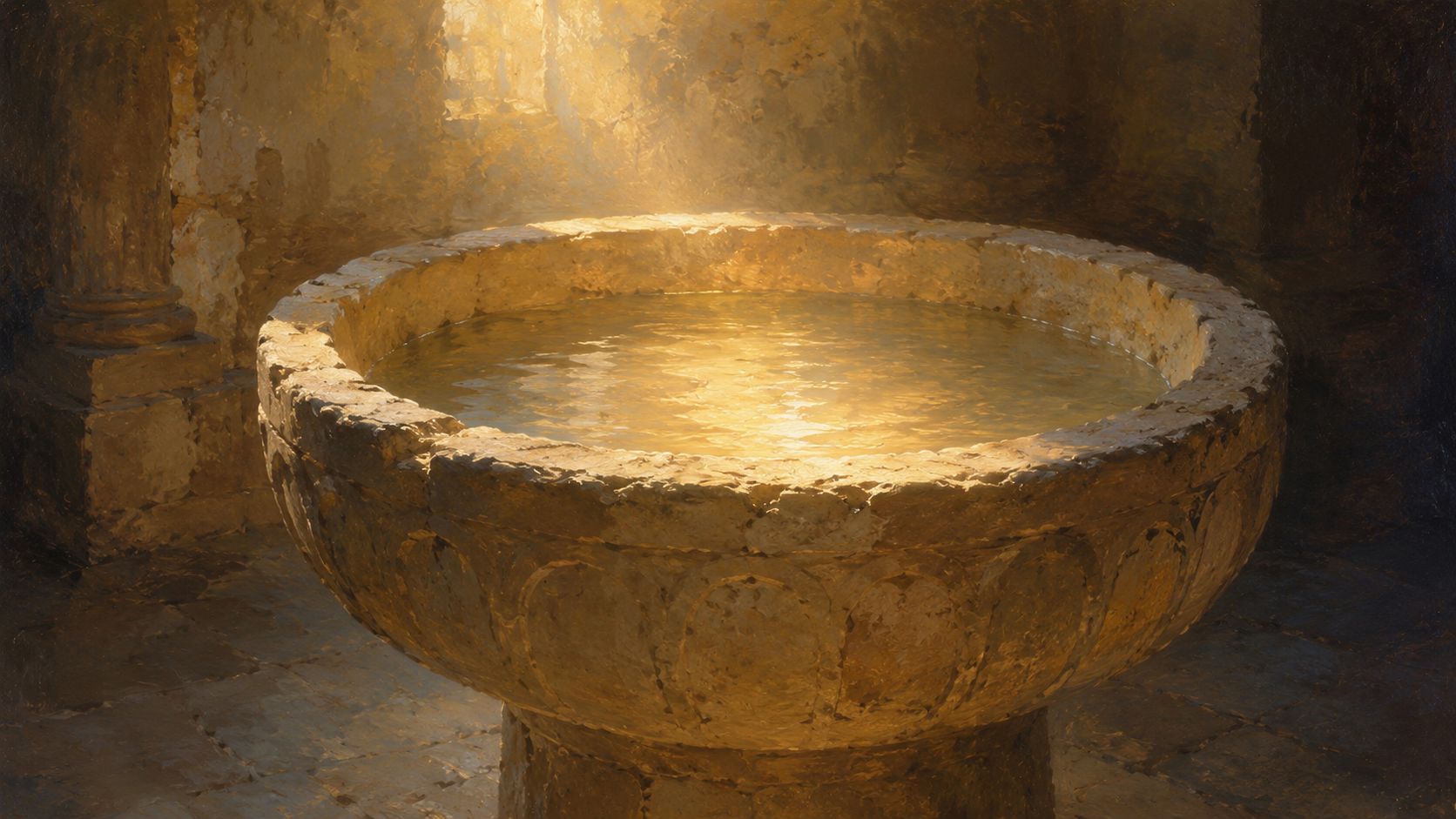
It is to that uncertain company that the risen Christ entrusts the heart of his commission: “Go therefore and make disciples of all nations, baptizing them in the name of the Father and of the Son and of the Holy Spirit.” One name — singular — shared among three persons. And baptism does something more than mark a person with that name; it sets the person down inside it. To come up out of the water, or to feel it poured over an infant’s head, is to be relocated — moved into the love of the Father that called the world into being, into the life of the Son who went to the cross and is risen, into the fellowship of the Spirit who keeps the church alive across the generations.
This is the deepest fact about a baptized life, deeper than any achievement or failure or feeling. To be baptized is to live inside the triune life of God. And nothing — not doubt, not failure, not the worst Thursday night a person has ever lived through — can undo it. There is no rite of un-baptism. The Name, once given, holds.
The God Who Does Not Leave
And then the last word: “And remember, I am with you always, to the end of the age.” It sounds, at first hearing, like a new promise. It is in fact the oldest promise in the Bible, spoken by a new voice.
Go back to the burning bush. Moses, a fugitive shepherd in Midian, sees a bush that burns without being consumed, and the voice of the LORD speaks from it: “I will be with you” (Exodus 3:12). It is what God says to the one being sent; Moses will not go to Pharaoh alone. And the same voice keeps speaking down the centuries. To Joshua at the edge of the promised land: “As I was with Moses, so I will be with you” (Joshua 1:5). To Israel in exile, its temple rubble and its land lost: “Do not fear, for I am with you; do not be afraid, for I am your God” (Isaiah 41:10). Even there. Even when every appearance argued that God had gone.
Every time God sends someone, God goes with them; no one is ever sent alone. What the risen Christ does on the mountain is to take that ancient sentence onto his own lips and change its tense — not God will be with you, but I am with you. The promise once spoken to Moses and to the exiles is now spoken by the risen Christ himself, in the first person.
Matthew, alone among the four evangelists, narrates no ascension. There is no cloud, no lifting away, no closing of the door. The Gospel simply ends with Jesus on the mountain, still standing, still speaking, still present — because that absence of an exit is Matthew’s whole point. He did not leave. The same Christ enthroned at the Father’s right hand is the Christ who is with you now: not a memory, not a set of teachings followed from a distance, but a presence, in the way God has always accompanied the ones he sends.
This is what Trinity Sunday is finally about. Not a metaphysical puzzle, and not three remote persons hovering in abstract perfection. The doctrine of the Trinity is the church’s grammar for the abiding God — its way of confessing that the God who made us has not left, the God who redeemed us has not abandoned us, the God who breathes life into us is breathing still. There is no day outside that presence. Not Monday morning at a desk, not the evening when loneliness turns sharp, not the hospital room, not the silent kitchen table; not the worst day, and not the best. Always — all the days, every one — until presence at last passes into sight.
The Brackets Close

So the brackets of the Gospel close. Emmanuel at the beginning; I am with you always at the end. And on the mountain they close upon a triune Name — the God who is with us revealed as Father, Son, and Holy Spirit, one God and one name and three persons, an ocean of grace deep enough to hold every wavering worshipper who has ever made the climb.
The doctrine does not have to be solved first. The eleven on the mountain had not solved it; they worshipped and doubted in the same breath, and were commissioned anyway. What is asked is not mastery but presence — to stand on the mountain, to fall on one’s knees, and to trust that the Lord who commissions wavering worshippers will go with them into whatever comes next. The story that opened with a name spoken over a sleeping man ends with a promise that carries no expiration: I am with you always, to the end of the age.
A Closing Prayer
Loving Father, whose love called us into being; risen Son, whose name we carry in our baptism; Holy Spirit, communion-keeper, who holds us together when we would fly apart — keep us in the Name into which we have been baptized.
Commission us, even in our wavering, and be with us, as you have promised, all the days, until we see you face to face.
In the name of the Father, and of the Son, and of the Holy Spirit. Amen.