
“Rise and Follow”
The Worst Address in Town
The morning is already hot when Jesus comes down the road into Capernaum. Dust hangs in the light off the lake; down at the shore the fishermen are bent over their nets, and the smell of brine and woodsmoke drifts up into the streets. And there, where the trade road meets the town, sits the one structure everyone passes without meeting its keeper’s eye — the toll booth.
Behind a low table, under a strip of awning, a man sits among his coins. Bronze and silver are stacked at his elbow; a ledger lies open; a set of scales waits to settle the next dispute. His name is Matthew, and in Capernaum his name is a curse people spit. To feel why, one has to know what the booth was. The town sat on a trade road near the border of Herod’s Galilee, and the man at the booth — the telōnēs — was no salaried clerk. He had bought the right to collect: he paid his contract upward to the agents of Rome and kept whatever he could squeeze from the farmers and fishermen who passed. That made him two despised things at once — a collaborator with the occupying power, and a man grown rich on his own neighbors’ losses. The rabbis filed toll collectors in the same drawer as robbers. Everyone who walked this road had long ago decided who he was.
Jesus stops in front of the table. The crowd at his back goes quiet. He does not reach for the ledger; he does not ask for an account. He looks at the man sitting among the coins, and he says two words.
“As Jesus was walking along, he saw a man called Matthew sitting at the tax booth; and he said to him, ‘Follow me.’ And he got up and followed him.”Matthew 9:9 (NRSV)
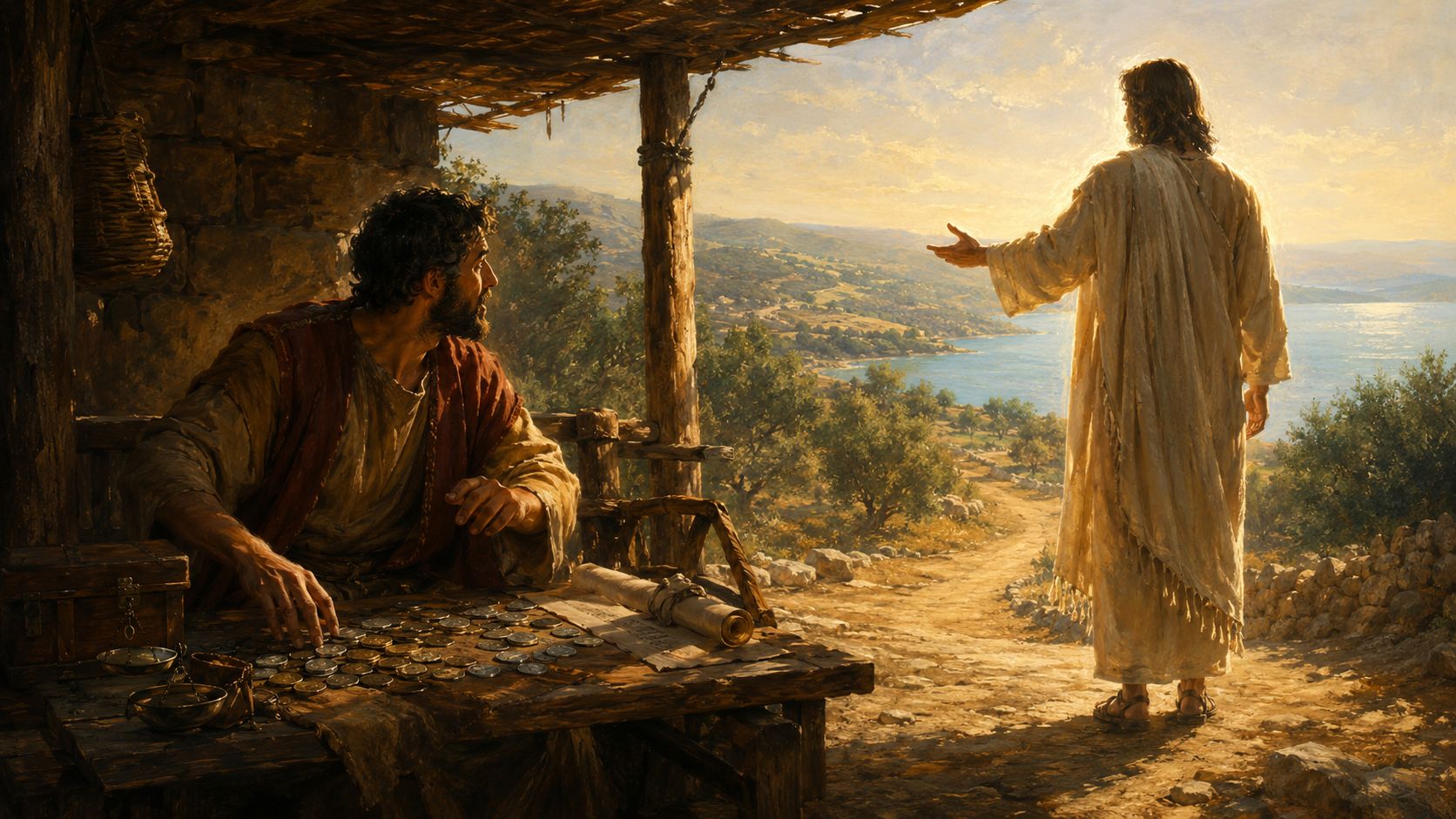
There is no sermon first. No probation, no “clean up your life and then we’ll talk,” no résumé reviewed, no restitution arranged. Two words — and then the most economical sentence in the Gospel: and he got up and followed him.
The verb beneath got up is anastas — he rose. It is a small word doing quiet, enormous work, because it belongs to the same family the Gospel will reach for at the end, when a body comes out of a tomb. A man who was, for all anyone could see, dead in his trade — fixed on his stool, settled in the very work that defined his exclusion — rises at a word. Before this same chapter is over, Jesus will take a dead girl by the hand and she will rise by that same verb. The call of the tax collector is, in miniature, a resurrection: grace speaks, and a man who was finished gets up.
If the pattern feels old, it is. Long before, a voice had said to a wandering Aramean, Go from your country and your kindred to the land that I will show you — and the report came back with the same spare wonder: So Abram went. No map, no guarantee — a word, a rising, and a future opened by nothing but trust. And the Psalter names what kind of word this is.
“By the word of the LORD the heavens were made … For he spoke, and it came to be; he commanded, and it stood firm.”Psalm 33:6, 9 (NRSV)
The voice that flung the stars into place, that called Abram out of Haran, is the voice that now lifts one despised man off his stool in Capernaum. Creation and conversion turn out to be the same kind of miracle: God speaks, and what was not, is. A moment ago there was no disciple at that booth; now there is one. The word did it — not by finding a worthy man and rewarding him, but by making a follower out of a collaborator, the way it once made light out of the dark.
The Guest List of Grace
By evening the lamps are lit in Matthew’s house, and the courtyard is full. Watch who comes through the door: tax collectors and sinners — his old crowd, the whole disreputable guild — settling onto the cushions, reaching for the bread, laughing a little too loudly. And in the middle of them, propped on one elbow at the table, is Jesus. Feel how scandalous the picture is. In that world the table was the sharpest boundary there was; whom a person ate with announced whom they belonged to. To recline at a man’s table was to say, in public, these are my people. And here is the holy one, the teacher, stretched out at dinner with exactly the people holiness was supposed to keep at arm’s length.
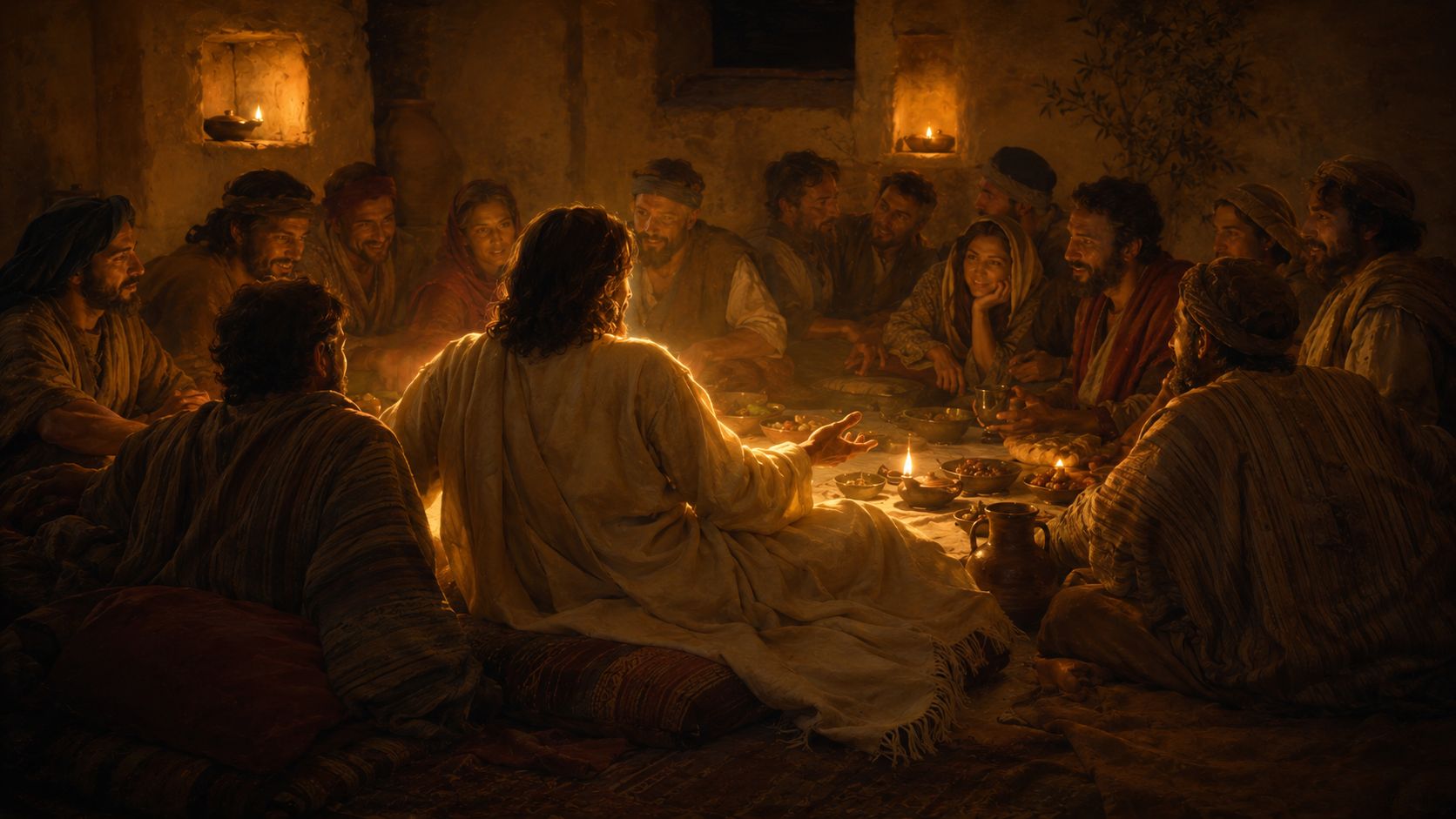
Out in the courtyard the Pharisees see it, and they are appalled. They do not confront Jesus directly; they pull his disciples aside. Why does your teacher eat with tax collectors and sinners? By their lights it is a fair question. They had built their whole faith on a sensible principle: holiness is fragile, and you guard it by separation — keep the clean from the unclean, the righteous from the sinner, lest the brokenness spread. And Jesus, overhearing, takes the principle and turns it inside out.
“Those who are well have no need of a physician, but those who are sick … I desire mercy, not sacrifice. For I have come to call not the righteous but sinners.”Matthew 9:12–13 (NRSV)
The table is not the place where the sickness creeps into him; it is the clinic where his healing spreads to them. His holiness is no fragile thing to be walled off — it runs outward, the way light fills a room no one can defend the dark against. And then he sends the experts back to school. Go and learn what this means is the very phrase a rabbi used to send a student back to the text — and the text he hands them is Hosea: I desire mercy, not sacrifice. They had mastered the machinery of religion and walked straight past its heart. What God wants is mercy. The crowded, disreputable table is not Jesus slumming; the verb he uses — call — is the same one he spoke at the booth. Gathering these people in was the very thing he came to do.
Who Sits at the Table
The lamps in Matthew’s house burned out twenty centuries ago, but the question asked in that courtyard has never stopped echoing — because in the end it belongs to everyone who has ever loved God. Who is at the table? And whom has respectability quietly crossed off the list? Every community gathered around grace eventually meets the temptation the Pharisees fell into: to mistake separation for holiness, to draw the circle of the acceptable a little tighter than God draws it. Most people keep a guest list somewhere inside them — a private register of who counts and who is too far gone, too compromised, too much. And still the gospel keeps walking past the temple steps to stop at the toll booth.
For the call still comes to the booth. It comes to the people the respectable have crossed out, and just as often to the people who have crossed out themselves — certain that what they have done, or failed to do, has already settled who they are; that the name others say, or the name whispered in the dark, is the last word. It is not the last word. The last word is Follow me. No one has been struck from the list. The same voice that called the heavens into being, and a tax collector off his stool, knows every name, and is not finished speaking it.
And the strange thing is, the party never ended. Christ is still reclining at a table respectable religion would never have set, still seating the people the rest would seat last, still calling the ones everyone else gave up on. The only ticket is the one Matthew had — the willingness to get up when his name is spoken. To rise. And to follow.

A Closing Prayer
Lord Jesus, you walked past every respectable address and stopped at the worst one, and you called us by name before we had earned a single thing. Thank you for a word that lifts the written-off off their stools, and for a table wider than our judgment. Give us the courage to rise when we hear you, a guest list as wide as your mercy, and a holiness that runs outward — toward the very ones we were taught to avoid. And where any heart is sitting this morning at its own toll booth, certain it is finished, let it hear the two words that begin everything: Follow me.