
“Great Is Your Faith”
The Other Half of the Picture
Last Sunday we left twelve men in a boat at dawn and one word ringing over the water: you of little faith.
This Sunday Matthew turns the page and hands us the other half of the picture.
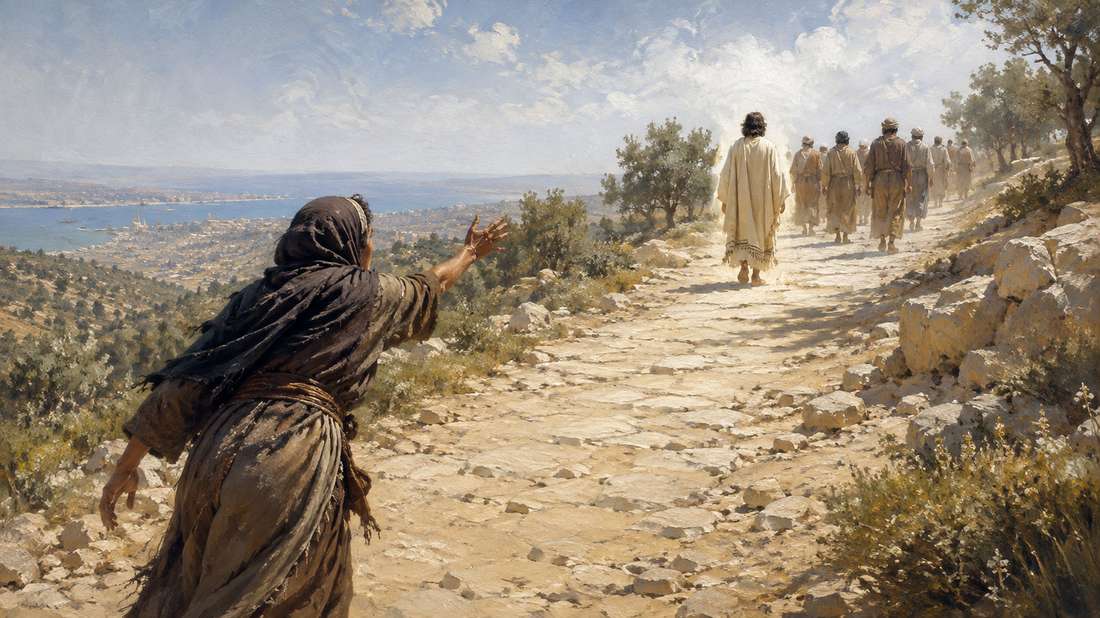
Jesus goes north out of Galilee, into the district of Tyre and Sidon — Gentile country. And a woman comes out of it, shouting after him.
Matthew calls her a Canaanite — a word centuries out of date, Israel’s oldest name for the enemy. He hangs it on this mother before she opens her mouth.
Then he lets her open it.
“Have mercy on me, Lord, Son of David; my daughter is tormented by a demon.”Matthew 15:22 (NRSV)
Hear what she has just done. She has prayed the Kyrie — have mercy — the oldest prayer we have, the one we still sing. And she has called him Son of David: Israel’s own messiah, confessed out of a Canaanite mouth a full chapter before Peter gets there.
Her theology is not the problem. It never was.
Not a Word
“But he did not answer her at all.”Matthew 15:23 (NRSV)
The Greek is blunt: he did not answer her a word. Not a no. Not a wait. Nothing.
Some of you know that silence at close range. The prayer you have prayed so often you stopped hearing yourself pray it. The same name brought to God week after week, nothing coming back. And then the thought at three in the morning: maybe the silence is the answer.
When that thought comes, put her in front of it. She is in the Bible on purpose. The silence was not the verdict.
The disciples break the silence first, and badly. Send her away, she keeps shouting after us — the same word they used on the hillside with five thousand hungry people. Twice now, their answer to a need they cannot meet is distance.
And Jesus answers them — them, not her: I was sent only to the lost sheep of the house of Israel.
A hard sentence, and we are not going to sand it down. The promise ran through Israel first — Paul spends three chapters insisting God has not gone back on it. Nothing here is taken from the children.
The Crumbs That Fall
She does not leave. She comes closer, and she kneels — Matthew uses the worship word — and prays the shortest prayer in the Gospel. Three words, and not one of them for herself. Lord, help me.
And then comes the sentence we all flinch at.
“It is not fair to take the children’s food and throw it to the dogs.”Matthew 15:26 (NRSV)
In that world, “dog” was a fence, and everyone knew which side of it she was on.
Now watch what she does with it. She does not argue with the fence. She says Yes, Lord — and then the quickest-witted sentence anyone says to Jesus in the Gospels.
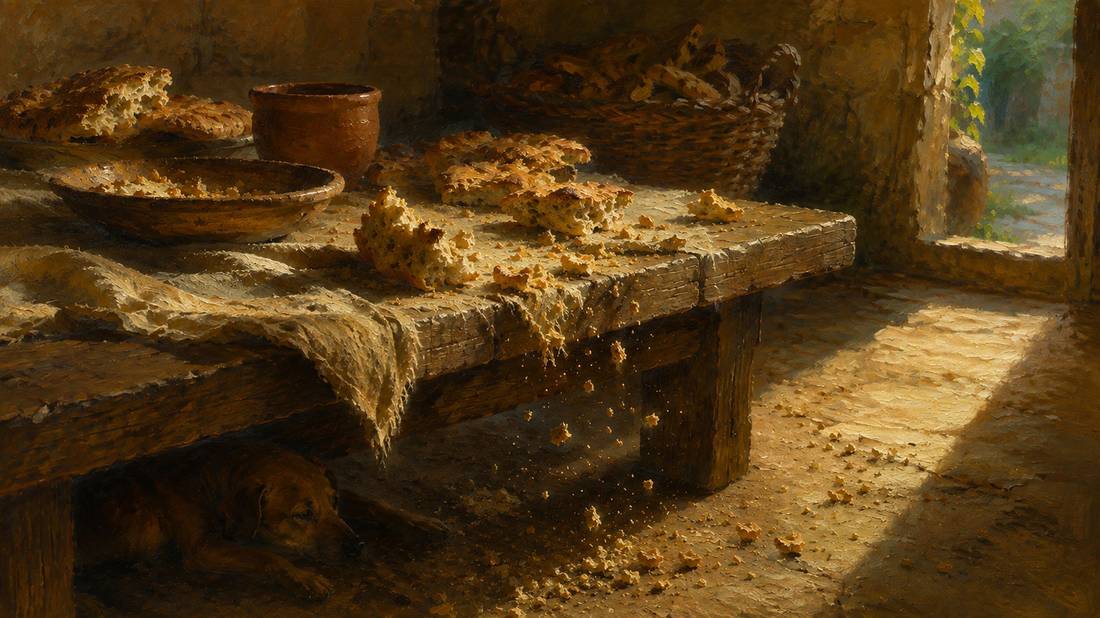
“Yet even the dogs eat the crumbs that fall from their masters’ table.”Matthew 15:27 (NRSV)
She has done the arithmetic. She was not there, but she has heard how it went: five loaves, five thousand fed, twelve baskets left over. Twelve baskets. She knows what a table like that does. It overflows. Crumbs off a table like that are not a consolation prize; they are a feast.
Twelve men carried those baskets down the hill and never worked it out. She works it out from outside the family, with a sick child at home.
Two Verdicts
“Woman, great is your faith! Let it be done for you as you wish.”Matthew 15:28 (NRSV)
In the Greek, great comes first: great — your faith. It is the only time in all of Matthew that Jesus calls anyone’s faith great. Not Peter’s. Not the Twelve’s. Hers.
He says little faith five times in this Gospel, always to an insider. And the one faith he calls great belongs to a woman standing outside the family altogether. Which leaves us something we cannot un-know: the size of a person’s faith has nothing to do with which side of the door they started on. Not membership. Not lineage. Not how many years your family has been in the building.
He had already moved that fence earlier in this same chapter — what defiles is not what goes in but what comes out. Never the border. Always the heart.
And her daughter was healed instantly — from that hour, Matthew says. He never goes to the house. The child is well before her mother can get home.
Others Besides
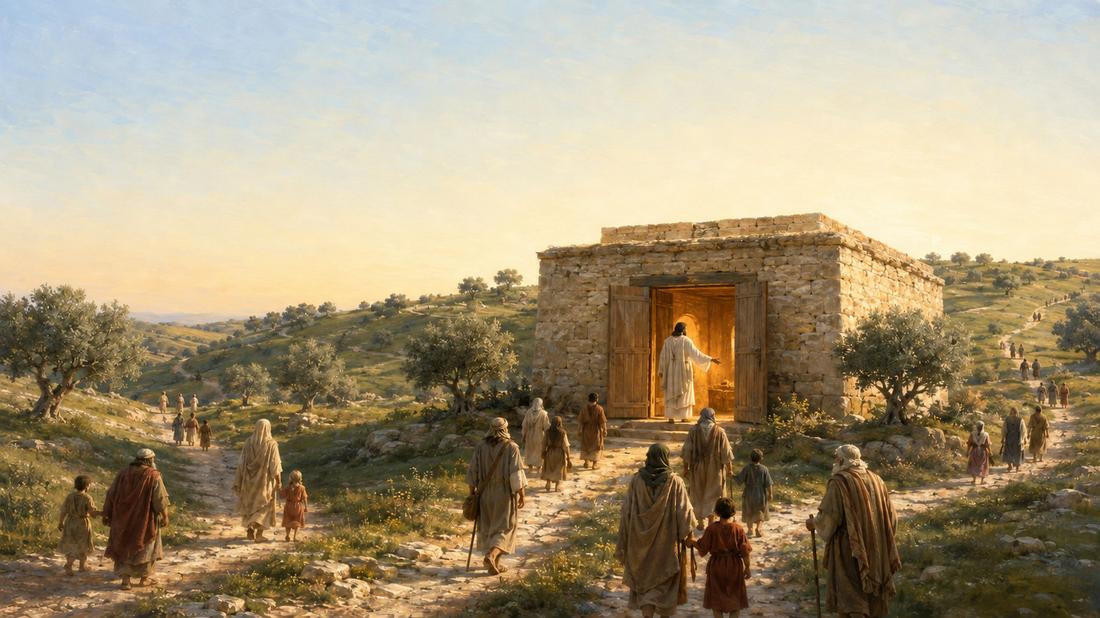
A few verses past where our reading stops, Jesus goes up a mountain on that same Gentile ground and feeds four thousand people. Seven baskets left over.
The crumbs turned into a banquet inside the same chapter.
That is the God we are dealing with: not a God who runs short. She was not fed instead of the children; she was fed because the children’s table overflows, and always has.
And this Sunday, that is exactly what our sanctuary looked like: two congregations in one room, singing a psalm that says all the peoples twice, in a house the prophet named long ago — a house of prayer for all peoples. And then the take-home line: I will gather others to them besides those already gathered.
Others besides. That is not a special arrangement for one August Sunday. It is God’s standing habit: whoever is already gathered, God is gathering more.
So hear it — hosts and guests both, and by now I am not sure which of us is which.
You are seen. The silence was not the verdict — she was seen from the first word she shouted at his back.
You are loved. The fence was not the last word — there was never any crumb-sized mercy in him, and there is none now.
And grace has not finished with you yet. The door you started on is not the measure — the faith he called great was standing outside the family when the day began.
A Closing Prayer
God of the overflowing table: we have been the children with bread to spare and the stranger hoping for crumbs, and you have fed us in both places. When you are silent, keep us asking. When the line seems drawn, give us her wit and her yes. Gather into this house others besides those already gathered. And over the little we bring, say what you said over her — let it be done as you have said.
In the name of the Father, and of the Son, and of the Holy Spirit. Amen.