
“The Storm He Sent Them Into”
The Boat, Again
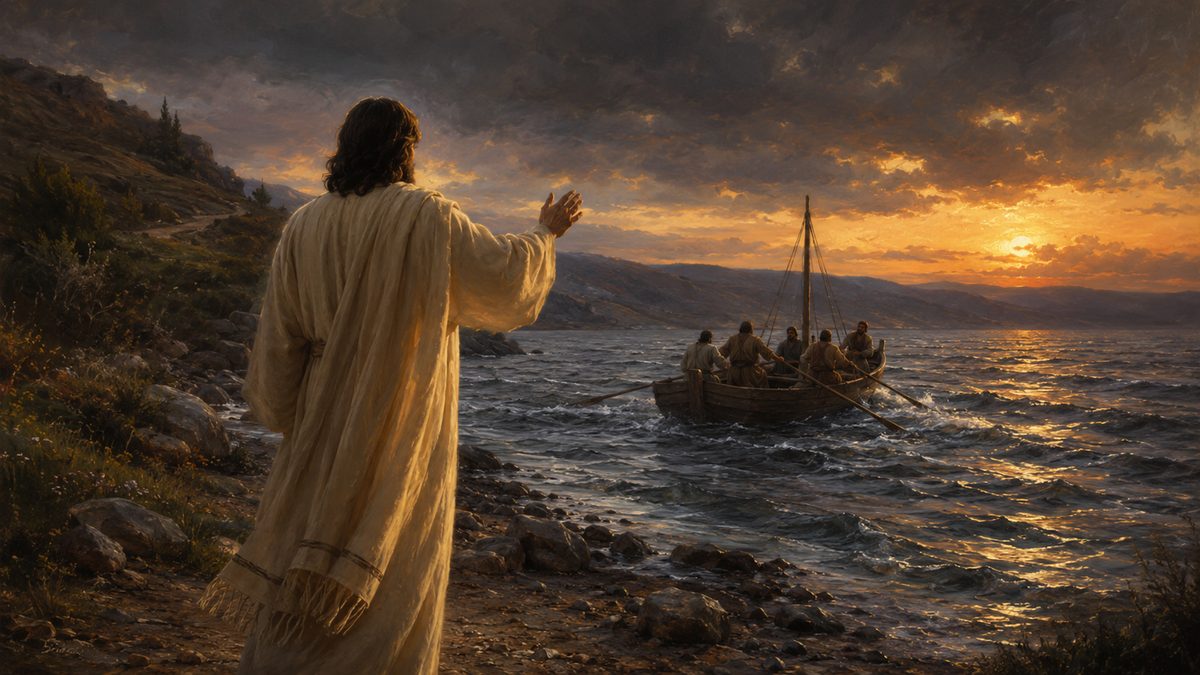
The baskets are barely gathered. It is the same evening as last Sunday — same shore, same twelve men, same boat.
But listen to how it starts.
“Immediately he made the disciples get into the boat and go on ahead to the other side, while he dismissed the crowds.”Matthew 14:22 (NRSV)
Made.
Not invited. Not suggested. Compelled — that is the force of the word. Whatever those twelve wanted, they were put on that water. By him.
Then he dismissed the crowds and went up the mountain by himself to pray — the solitude he had been trying to reach since the news of John’s death. Night comes down. Jesus, alone on the mountain, praying — and twelve obedient men in the middle of the lake, the wind turning against them.
They had not wandered off. They were not being punished. They were exactly where obedience had put them.
The Fourth Watch
Matthew says the boat was battered by the waves. His word is violent: tormented, worked over.
And then nothing happens for a very long time.
Between two verses, an entire night goes by. When something finally does happen, it is the fourth watch — three to six in the morning, the last watch and the coldest. Nine hours rowing into that wind, in the dark. Matthew offers no explanation for the delay, and I will not invent one.
Some of you are in a storm you can trace back to doing the right thing. The caregiving that is wearing you down. The job you left, the truth you told — and the wind turned. And the quiet arithmetic starts: if I were really following God, would it be this hard?
This text breaks that arithmetic. They were in the storm because they obeyed. The fact that it is hard is not evidence that you heard him wrong.
Come
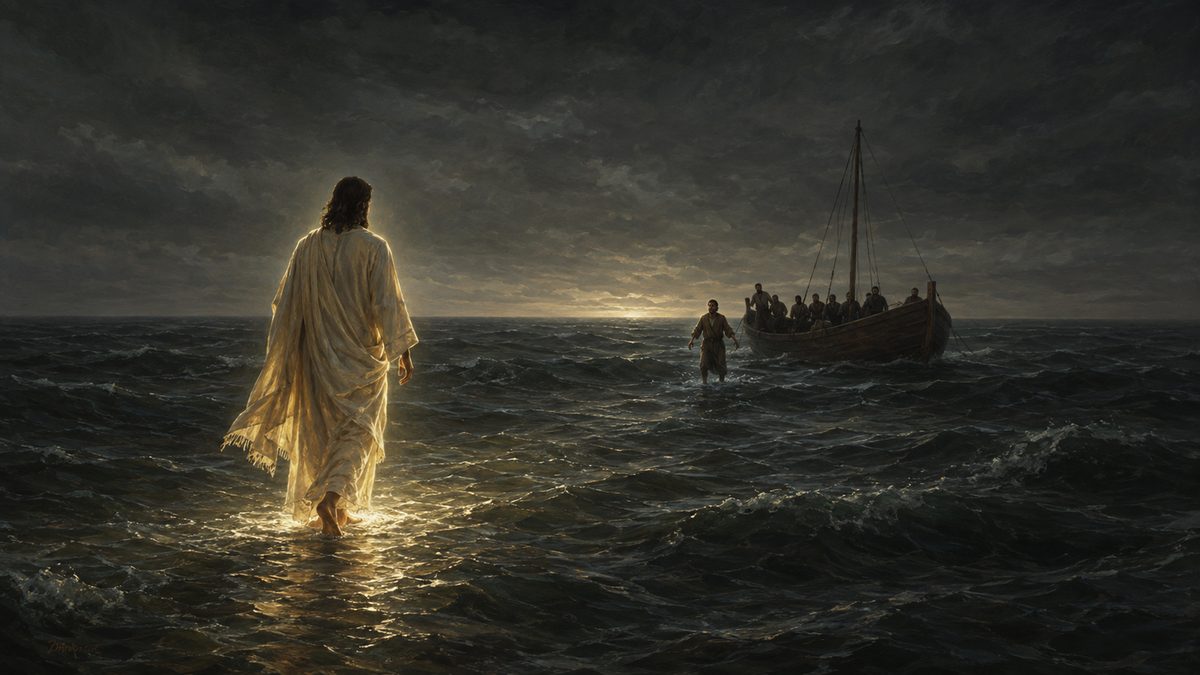
And in that fourth watch, he came walking toward them on the sea.
In Israel’s scriptures, only God walks on the sea. The psalm appointed for this Sunday says it quietly: righteousness will make a path for his steps.
The disciples see a figure and conclude what frightened people conclude in the dark: it is a ghost.
I know that boat. I got into it the way they did — gladly, no fear, no bargain, just the joy of going where he goes. And still the wind turned. More often than I like to admit from a pulpit, ministry has put me in the middle of that lake, and I could not feel him anywhere. I complained — to God, about God, in the same breath. If faith has a size, mine would not have impressed anyone.
And it is to people like that — people like me — that the voice comes across the water:
“Take heart, it is I; do not be afraid.”Matthew 14:27 (NRSV)
He gives them his name in the dark. While the wind is still blowing. Before any of them believes anything.
Then Peter asks the best question in the chapter. He does not say, prove it. He says, Lord, if it is you, command me to come to you on the water. Command me — an order. To you — a destination. And Jesus grants it in one word: Come.
And Peter walks — he got out of the boat and came toward Jesus. Whatever else we say about Peter, that happened.
And then he noticed the strong wind, and he became frightened. You cannot see wind. Nothing out there had changed — what changed was where he was looking. The moment my eyes leave him, whatever surrounds me swells bigger than it is. He begins to go under, and out of him comes the best prayer in the chapter. Three words.
“Lord, save me!”Matthew 14:30 (NRSV)
The Hand
“Jesus immediately reached out his hand and caught him, saying to him, ‘You of little faith, why did you doubt?’”Matthew 14:31 (NRSV)
Immediately. No pause to let the lesson sink in. And the grip is not a touch on the shoulder; it is the grab you use on someone you refuse to lose — a fist closed around a wrist. Peter’s concentration had already failed. What saved him was a hand.
And then — only then, with Peter’s wrist locked in his grip — comes the question: you of little faith, why did you doubt?
Everything is in the order. And some of us were raised in the reversed version.
Hear the word itself, too. Little faith is not no faith. In this Gospel, Jesus says it only to his own disciples, and always while he is helping them. He tells Peter the size of his faith while he is lifting him out of the water. That is how you speak to someone you love who scared you.
So if anyone has ever told you — at a bedside, or at three in the morning — that if your faith were bigger the storm would have stopped by now: this verse is the answer. Peter was not left in the water until he got it right. Paul says it outright: no one who believes in him will be put to shame. What held was never Peter’s grip on Jesus. It was Jesus’ grip on Peter.
I can tell you what that grip looks like in my life. Never anything spectacular — no parted sky. Usually a reminder, handed to me rather than summoned, of who is with me: beside me, ahead of me, behind me, in me. And whatever had swelled up to swallow me shrinks back to its true size.
Those in the Boat
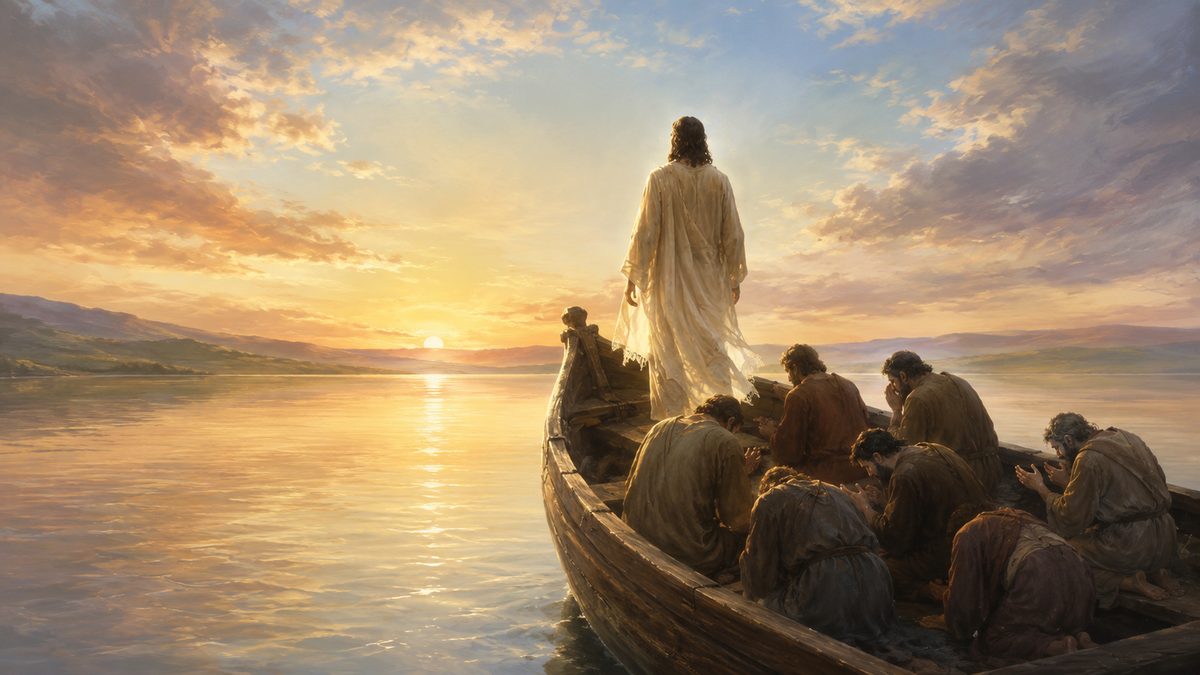
“When they got into the boat, the wind ceased.”Matthew 14:32 (NRSV)
No command this time — no word addressed to the weather at all. He climbs in, and it stops. Elijah, in this Sunday’s first reading, met God not in the wind or the earthquake or the fire, but in a sound of sheer silence. The twelve met him in the wind itself. God is not reliably in the storm, and not reliably in the quiet. God is reliably God. The promise is not better weather; it is presence.
Then comes the line everybody forgets.
“And those in the boat worshiped him, saying, ‘Truly you are the Son of God.’”Matthew 14:33 (NRSV)
It is the first time in the whole Gospel that human beings say that sentence — and it is not Peter. It is the ones who never got out of the boat, whose entire part in the miracle was surviving the night. If your story of faith is that you stayed at the oars until morning, the church’s first confession belongs to you.
One more thing, from Matthew’s last page. Peter’s word for doubt appears exactly twice in the New Testament. Here — and on the final mountain, where they worshiped him, but some doubted. And the risen Jesus sent that wavering room out anyway. The church that doubts is the church that gets sent.
So hear it, before you row back out into whatever water you were sent into.
You are seen. The fourth watch was not too dark for him to come to you.
You are loved. Caught first, asked after — and that order will never reverse.
And grace has not finished with you yet. The waverers were the ones he sent.
A Closing Prayer
Lord of the fourth watch: we are not always lost when we are in deep water — sometimes we are exactly where you sent us. Come to us while it is still dark, and say your name over the noise. When our eyes leave you for the wind, catch us first and teach us after. Give us the little faith that calls your name going under. And when the wind finally stops, find us worshiping — wavering, and worshiping — and send us anyway.
In the name of the Father, and of the Son, and of the Holy Spirit. Amen.