
“He Tried to Go Away”
The Boat
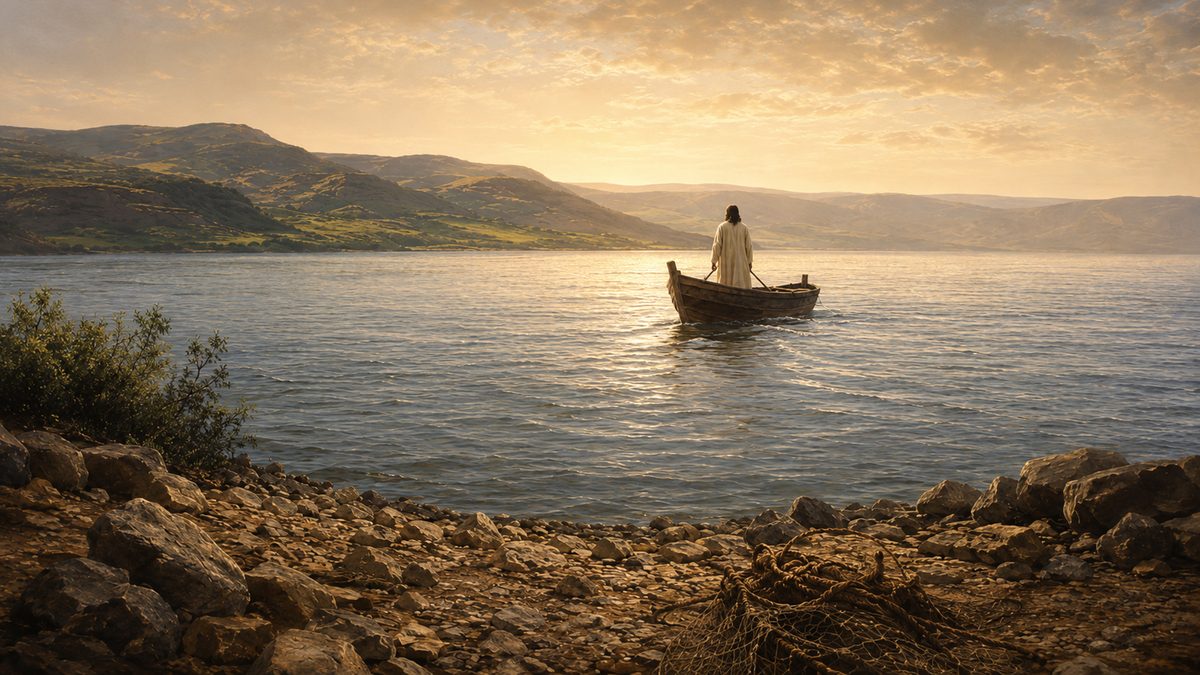
The story everyone knows begins with five loaves and two fish. Matthew begins it with a funeral.
A girl danced at a birthday party. A king, pleased and cornered in front of his guests, made a promise he could not take back, and a prophet’s head came into the banquet hall on a platter. When it was over, John’s disciples came for the body and buried it. And then Matthew adds the small clause that turns the whole chapter: they went and told Jesus.
“Now when Jesus heard this, he withdrew from there in a boat to a deserted place by himself.”Matthew 14:13 (NRSV)
It is worth standing still long enough to see what is behind him as he steps into that boat. His hometown has just finished telling him who they think he is — the carpenter’s son, nothing more. The man who baptized him in the Jordan is dead. And the king who killed him has begun asking questions about the next prophet drawing crowds in Galilee.
He wants one afternoon. Water, distance, no one asking anything of him. It is the only thing he asks for in the entire chapter.
He does not get it.
The Beach
The crowds see which way the boat is pointed and start walking. Matthew spends a single word on the journey — on foot — and leaves the rest to the imagination: miles of shoreline, in the summer heat, around the top of a lake, because a man got into a boat and they could not bear to let him go.
So the beach is already occupied when he lands. They are standing there with their sick.
“When he went ashore, he saw a great crowd; and he had compassion for them and cured their sick.”Matthew 14:14 (NRSV)
Not one word about the timing. No sigh, no rebuke, no come back tomorrow. Matthew does not even pause to admire the restraint; he simply records what happened next, which was healing.
This is not a text against rest. Nine verses later Jesus sends every one of them home, climbs a mountain alone, and finally gets his evening. He takes back what the crowd cost him. But not yet, and not here. The word Matthew reaches for is a word about the inside of the body — the gut turning over. Compassion in this Gospel is never a mood worked up for the occasion. It happens under the ribs, and then it moves out into the hands.
Paul knew that arithmetic from the inside. He opens his letter to the Romans carrying great sorrow and unceasing anguish for his own people, and keeps working anyway, and refuses to let them go: to them belong the covenants, the promises, the patriarchs. Present tense. Still theirs. Grief and faithfulness have never been required to take turns.
Which is the first thing this beach says about God. Compassion does not wait until the compassionate one has recovered.
Send Them Away
The light goes long, and the disciples come with a plan. It deserves a fair hearing, because it is a good plan.
“This is a deserted place, and the hour is now late; send the crowds away so that they may go into the villages and buy food for themselves.”Matthew 14:15 (NRSV)
Look for the flaw in it. The place really is deserted. The hour really is late. The people really do need to eat, and the villages really do sell bread. This is competent, responsible ministry from exhausted men at the end of the longest day any of them has had — and it ends with five thousand people walking home hungry.
It is the proposal almost everyone has made at some point about a marriage, a diagnosis, a child: this is more than can be handled here; send it somewhere with the resources. Not faithless. Sensible. Right about everything except who was standing in the circle.
And one word gives the whole plan away. The word is buy. The God of Israel has an old answer to that word, and it had been read aloud in the synagogue for centuries before anyone stood on that grass.
“Ho, everyone who thirsts, come to the waters; and you that have no money, come, buy and eat!”Isaiah 55:1 (NRSV)
Isaiah does not offer a better budget. He takes down the price.
Bring Them Here to Me
Jesus says no. They need not go away. And then he makes it considerably worse.
“They need not go away; you give them something to eat.”Matthew 14:16 (NRSV)
In Greek, that you is a word he did not have to say. The verb already carries the person; the pronoun is pure emphasis, and he puts it in front of the command anyway, so the sentence lands like a finger pointed across the circle. And notice what he never says, then or afterward: I will take it from here.
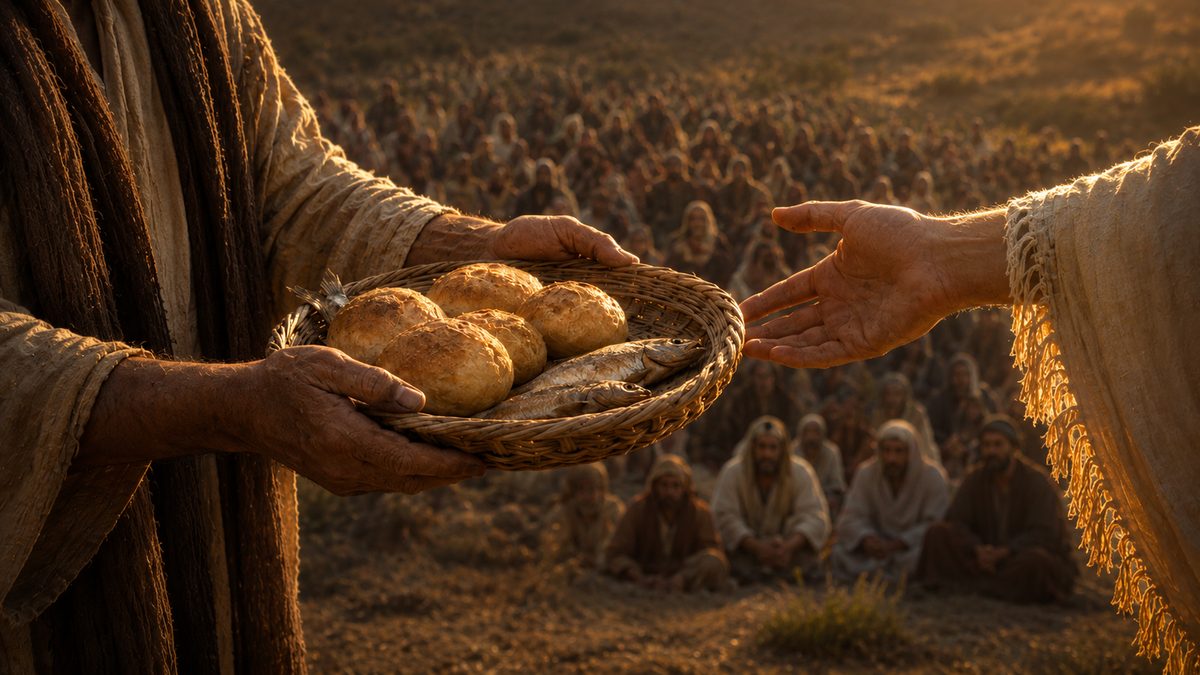
They answer with an inventory. Nothing here but five loaves and two fish. He does not argue with the count, and he does not tell them it is more than they think, because it is not — five loaves is not dinner for five thousand men, and everyone in that circle can do the arithmetic.
What he does instead is pick up their own word and turn it around. They said nothing here. He says: Bring them here to me. Their entire argument had been about the address — the bread exists, but not in this place — and he tells them that this place is precisely where he wants it. He does not ask for more. He asks for those. The five. The two. The thing already written off as insufficient, carried the few steps across the grass.
Then he sits five thousand people down on the grass. He takes the loaves. He looks up to heaven. He blesses, and breaks, and gives.
And then Matthew does something remarkable, which is nothing at all. There is no sentence in this Gospel where the bread multiplies. Nobody sees it happen. Between gave them to the disciples and all ate and were filled there is not one word of explanation, and the silence is not an oversight. Whatever happened, happened in the handing over, and Matthew leaves it exactly there.
But he is careful about whose hands are in the story. Jesus feeds no one directly on that hillside. He gives the bread to the disciples, and the disciples gave them to the crowds. The impossible command came true precisely as he had spoken it — and it came true with what they had called nothing.
Twelve Baskets
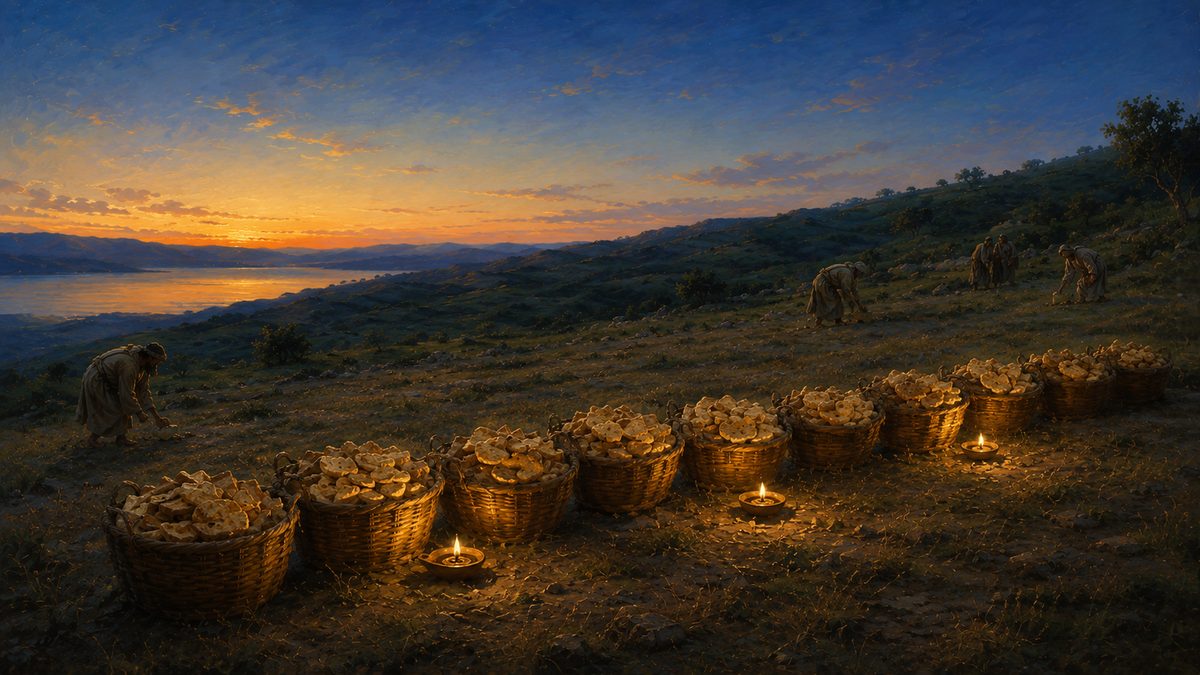
“And all of them ate and were filled; and they took up what was left over of the broken pieces, twelve baskets full.”Matthew 14:20 (NRSV)
That word filled is the same word Jesus used on another hillside, in the fourth Beatitude — blessed are those who hunger and thirst for righteousness, for they will be filled. Here, in a place everyone had agreed was empty, he pays the blessing out in bread. And the psalm appointed for the day names the God who does that kind of thing: you open your hand, satisfying the desire of every living thing.
Then the baskets. Not merely enough — left over, and gathered. Somebody walked that darkening grass afterward and picked the fragments up, one piece at a time, because the abundance of God has never once been careless. Twelve baskets, and twelve men who two hours earlier had said there was nothing here. One apiece. Each of them carrying home more than he brought.
And the ending almost nobody quotes: three verses later, he finally goes up the mountain by himself to pray. He does get his evening. It simply comes second.
A Closing Prayer
God who feeds people in deserted places: you saw us before we had said anything, and you have never once made us pay for the timing of our need. We keep handing you an inventory — the little we have, counted twice, and found wanting. Take it anyway. Bless it, break it, and put it back into our hands. Feed us at your table, and make us the hands that carry it out, until nothing you have given is lost. Amen.